MergeTree Settings That Change Behavior Between Managed Providers
Identical settings behave differently across managed providers, quietly breaking migrations.
The same MergeTree setting can mean two completely different things depending on which managed provider is running the table underneath, and this gets treated like it doesn't exist until it costs someone a production incident. Engineers migrate a schema, carry over their settings file, and then watch part counts creep up or TTL deletes stop firing on schedule. Nobody changed a config value. What changed is the engine actually executing the merges. This piece maps out where that gap appears, setting by setting, so migrating (or evaluating) doesn't mean finding out the hard way.
How the underlying engine architectures split
Every managed provider still lets someone type ENGINE = MergeTree() in a CREATE TABLE statement. That's the trap. Underneath the DDL, two genuinely different systems can be doing the work, and they don't behave the same way once data starts moving.
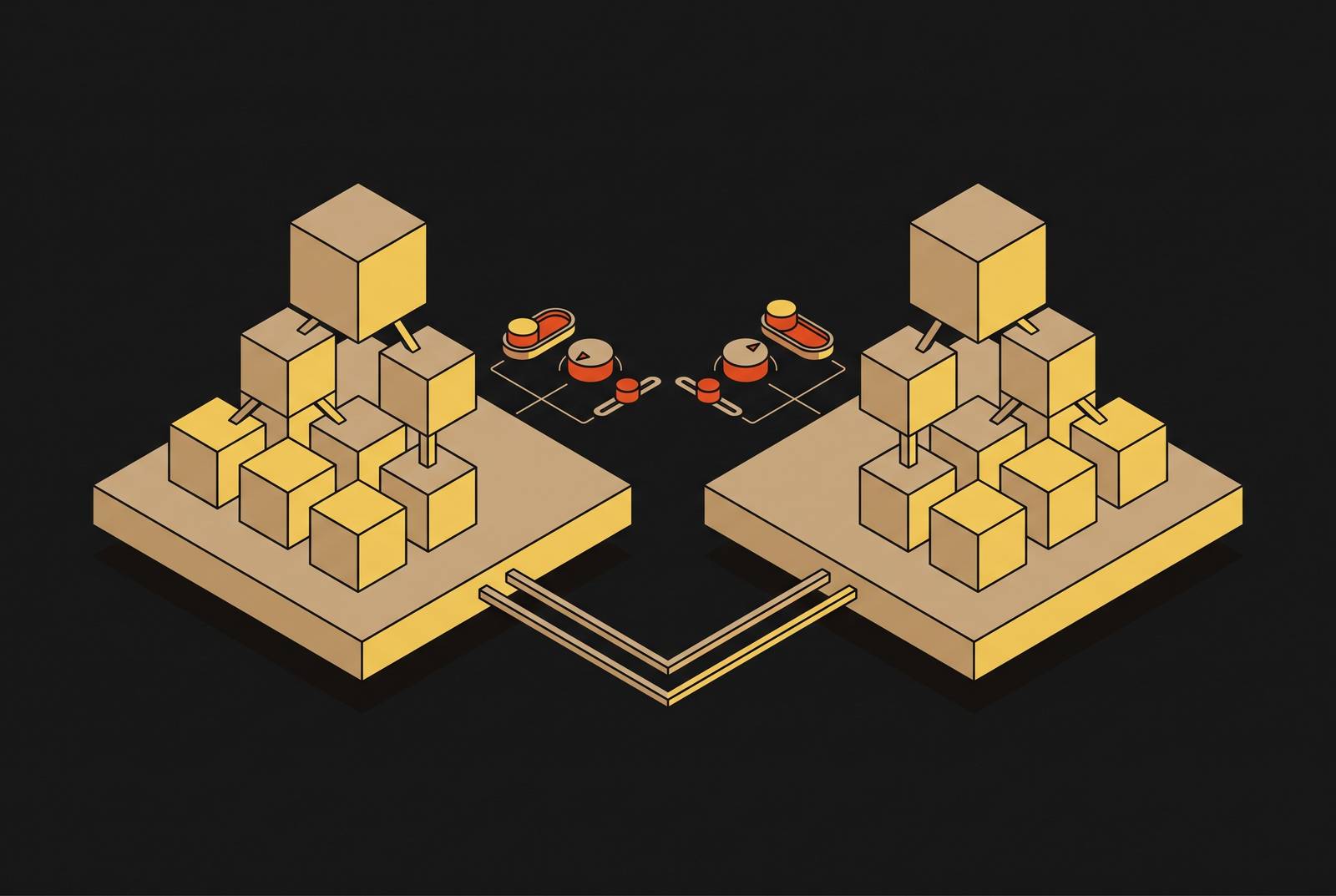
The older, more familiar model: each node keeps a full copy of the data on its own local disk. A coordination layer (built on a consensus-based service) tracks part metadata across replicas, but the actual bytes get fetched node-to-node when a replica needs a part it doesn't have yet. Adding a replica means that replica has to pull data across the network before it's useful. This is the model running under self-managed ClickHouse deployments and under providers that stick to the open-source engine.
The newer model flips the storage assumption entirely. Durable data lives in object storage (S3, GCS, Blob Storage, whichever the provider uses), and every compute node treats its local disk as a cache. Replication becomes a metadata-coordination problem because there's only one copy of the data and everyone reads from it. Scaling a read replica under this model means spinning up a compute node that starts serving queries with a cold (then warming) cache. No data movement required. That also means a single table under this architecture can support meaningfully more replicas than the local-disk model, where coordination overhead becomes the bottleneck as replica count climbs.
The trade-off is latency. Object storage is slower than local NVMe, full stop. Providers running this architecture compensate with read-ahead, multi-threaded I/O, and tiered local caching, but a cache miss still costs real time. This isn't the architecture to reach for if the workload needs single-digit-millisecond point lookups.
Why does this matter for settings specifically? Because any setting that assumes "parts live on local disk" or "replicas fetch files from peers" either does nothing or means something structurally different once the storage layer moves under it. A setting that used to control disk I/O now controls, at best, cache behavior. At worst, it's inert.
The object-storage engine is proprietary, available only through specific commercial offerings, not in the open-source community build. Providers running open-source ClickHouse are, by definition, running the local-disk replication model. And on the proprietary side, the server-level <merge_tree> config block that self-managed operators are used to editing directly is off-limits. Anything tunable has to go through per-table SETTINGS clauses, assuming the provider surfaces it there at all.
Where settings get exposed, capped, or removed entirely
A setting existing in ClickHouse's documentation says nothing about whether a given provider lets a user touch it. Access varies along three lines: whether the engine is the local-disk or object-storage variant, whether the provider exposes server-level config, and whether certain table engines are enabled at all.
The Kafka table engine is the clearest example of a hard architectural line rather than a tuning knob. Providers running the proprietary object-storage engine tend to disable it outright, pointing users toward managed ingestion pipelines instead, sometimes with a separate connector-based option for teams who want more granular control over topic and offset handling. That's not a settings change. That's ETL logic getting rebuilt from scratch, and any team whose pipeline leans on the Kafka engine plus materialized views for streaming transforms should treat this as a migration project.
Background pool controls tell a similar story. Settings governing background pool sizes and merge eligibility thresholds are staples of self-managed tuning. On the object-storage engine, server-level pool controls are generally not exposed to the user. The provider manages pool behavior on the user's behalf, for better or worse.
background_pool_size set at the session or user scope does nothing now. It's marked obsolete at that scope and appears as inert in system.settings, even though it's still a live setting at the server level in system.server_settings and config.xml. If expiration-related merges seem to be misbehaving, check the merge queue settings that govern how many expiration-related merges are permitted to run concurrently. Chasing the obsolete setting wastes time.
Per-table SETTINGS clauses via CREATE TABLE or ALTER TABLE MODIFY SETTING generally work across both architectures. Server-level overrides are the part that disappears outside self-managed and select open-source-based providers with full config access.
And then there's version pinning, which quietly gates settings access regardless of what the documentation promises. A feature that ships in a recent release simply isn't reachable if the provider has pinned an older build. This appears concretely in downstream tools: Langfuse's version 4 requires ClickHouse 25.12 or later (26.4 recommended) to use lightweight updates, the JSON type, and full-text search. Pin below that version, and the lightweight-update setting doesn't exist as far as that deployment is concerned, no matter how carefully it's configured.
TTL behavior gets murkier when someone else owns the merge pool
TTL settings look simple on paper. merge_with_ttl_timeout merge_with_ttl_timeout sets the minimum gap, in seconds, between two TTL-triggered merges on the same table, defaulting to 14,400 seconds, or four hours, a known quantity. That default is a known quantity. What's less well understood is what happens when the merge pool refuses the TTL merge task.
There's a documented bug (tracked as GitHub issue #119717, opened in September 2026) where an expiration-triggered deletion merge gets selected, the background merge pool rejects it, and the merge silently drops, but the partition's expiration timer has already been armed. The partition then gets vetoed from TTL selection for the entire four-hour window. Expired rows that should have been deleted just sit there, visible, for hours after pool capacity frees back up.
Why does this land harder on managed platforms specifically? Because pool sizing is the provider's decision, not the user's. On a self-managed cluster, an operator staring at a full merge queue can raise pool concurrency and clear the backlog. On a platform where pool controls aren't exposed, there's no lever to pull. The rejection that triggers the silent drop just happens, on the provider's schedule, not the user's.
That has real teeth for anyone treating TTL as a compliance mechanism. GDPR-style deletion SLAs, retention policies, anything assuming rows disappear on a fixed schedule, all of that quietly breaks if TTL merges get skipped without anyone noticing. The data isn't wrong. It's just still there, past when it was supposed to be gone, and nothing in a normal query result reveals that anything failed.
The ttl_only_drop_parts setting offers a partial hedge. Left at its default (off), ClickHouse deletes individual expired rows during a merge. Turned on, it drops entire parts once every row inside is expired, which is cheaper and lets a table run with a shorter TTL timeout since there's less merge I/O involved. Whether a given provider exposes that setting per table varies. Before trusting TTL for anything regulatory, check whether ttl_only_drop_parts is available, whether pool concurrency is visible or fixed, and whether merge queue depth can be monitored at all. Without visibility into the queue, that four-hour default is not a target but a floor, because nothing shows whether merges are keeping pace.
Part count and merge scheduling pull in different directions depending on the engine
ClickHouse's healthy-part-count guidance per partition is 3,000 now, up from an older default of 300. How a table actually gets there, and what happens when it doesn't, depends heavily on which merge model is running.
A handful of settings do the real work on the insert side. parts_to_delay_insert sets the threshold where ClickHouse starts throttling incoming inserts to buy the merge process time. parts_to_throw_insert sets the harder ceiling, where ClickHouse just rejects inserts outright. max_bytes_to_merge_at_max_space_in_pool caps how large a part can grow before it's no longer eligible for background merging. Queue depth for mutations and merges gets governed by their own replicated-queue limits.
On the local-disk replication model, all of these are visible, tunable, and meaningfully connected to what's happening on physical disk. A production-tuned self-managed configuration might look something like: background pool size at 32, schedule pool size at 128, fetch pool size at 16, max merge size capped around 150 GiB, insert delay threshold at 2,000 parts, insert rejection threshold at 5,000 parts. That's a real, working configuration pattern, and every value in it maps to something concrete happening on disk.
None of that is available or surfaced on the object-storage engine. The merge scheduler there runs against shared metadata, not local disk, and merge throughput becomes an infrastructure decision made by the provider rather than a dial the user turns. That's not a missing feature waiting to get added. It's a structural consequence of the architecture, and it's worth treating it that way rather than filing a support ticket expecting it to change.
The practical move for anyone migrating from a tuned self-managed setup: don't assume merge behavior will resemble what came before. Benchmark part accumulation under real production insert rates on the new platform before cutting traffic over, because the levers that used to fix a part-count problem might not exist anymore.
Durability assumptions and fsync settings that Kubernetes breaks quietly
MergeTree ships with fsync turned off by default, across the board: fsync_after_insert, fsync_part_directory, and the minimum-rows threshold for fsync-after-merge all default to zero or off. That's not an oversight. It's a deliberate bet that if a part gets lost before it hits disk safely, a peer replica has a copy and can hand it back over.
That bet only pays off if a peer replica actually exists. Consider what happens on a single-replica deployment running on managed Kubernetes, when the underlying node gets torn down mid-write, say during a routine node image upgrade that the operator didn't schedule around. The kernel hasn't flushed page cache yet. Recently written parts may not have been safely persisted to disk. There's no peer to fetch a good copy from, because there's no peer.
This isn't a ClickHouse bug. The settings do exactly what they're documented to do. The failure mode comes from the deployment topology creating a single point of failure that the default durability assumption was never designed to tolerate. Kubernetes operators can create exactly this condition without making that trade-off obvious to whoever's running the cluster.
Does the deployment actually run two or more replicas in production, or just one behind a service that makes it look redundant? Can fsync behavior be overridden per table if a single-replica topology is unavoidable? And does the platform's upgrade process drain a node gracefully before killing it, or does it just terminate on a schedule?
The object-storage engine sidesteps this particular failure mode, since durable data lives in object storage rather than page cache on a node that might disappear. That's a genuine durability advantage for this specific failure class, even with the latency trade-off that comes attached to it.
Engine variant choice matters less than what governs it
The MergeTree family covers a handful of specialized variants: one that deduplicates rows by sort key during merges, for upsert-style workloads. One that pre-aggregates during background merges, useful for materialized views tracking running totals, at the cost of more complex insert logic. A simpler cousin that just sums numeric columns during merges. And a pair built for row-level change tracking through insert-and-cancel pairs.
All of these variants are available across both architectures. Engine variant selection isn't where provider constraints bite, which is genuinely good news. The constraint sits one layer down, in the settings and infrastructure that decide when and how those merges actually run.
Mutations, an ALTER TABLE UPDATE or DELETE, rewrite entire affected parts in the background regardless of which variant is in play. On a platform where pool capacity is opaque and fixed, a large mutation can quietly queue up and start delaying other merges, TTL merges included. That's the same pool-contention problem from earlier, just triggered by a different kind of workload.
Partitioning design compounds the issue. Partition on something high-cardinality, a user ID or a request ID, and the table generates a flood of small partitions that pile pressure onto the merge process. On a platform with fixed pool settings, recovering from that mistake takes longer, because there's no way to temporarily throw more merge capacity at the backlog.
Compression is the one bright spot where none of this applies. Column-level, table-level, LZ4 by default with ZSTD as an option, compression settings behave identically regardless of provider or engine. ZSTD can meaningfully cut storage costs on high-cardinality string columns, and that benefit travels the same way everywhere.
Version pinning applies here too, separate from the engine question entirely. Langfuse's lightweight-update flag needs both a settings profile change and a ClickHouse version of 25.12 or newer. A provider pinned below that line blocks the feature no matter which MergeTree variant sits underneath, which is really a version story wearing a settings costume.
What version pinning does to settings availability over the long run
Every provider pins a ClickHouse version and upgrades on its own cadence, and that cadence is, practically speaking, a second settings layer sitting on top of everything discussed so far. A setting can exist, be well-documented, and still be functionally unavailable, simply because the platform hasn't shipped the version that introduced it.
That matters more over time than it does on day one. A team evaluates a provider, checks that the settings they need exist in the current documentation, and moves forward. Eighteen months later, a new feature ships, a downstream tool starts requiring a minimum version, and the provider hasn't caught up yet. The lightweight-update requirement is a live example of exactly this pattern: a dependency with a hard version floor, sitting on top of a provider's own upgrade schedule that nobody controls except the provider.
The honest framing here isn't "check the settings today." It's "ask how fast this provider moves, and how far behind it's willing to sit." A provider with a slow, conservative upgrade cadence trades feature currency for stability, which is a legitimate choice. A team relying on new capabilities landing quickly needs to know that trade exists before committing a schema and a settings file to a platform, not after a downstream tool refuses to start.
None of this is a case against managed ClickHouse. It's a case for reading settings as provider-specific facts, not universal ones, and checking version compatibility as carefully as checking a settings name against a table definition.