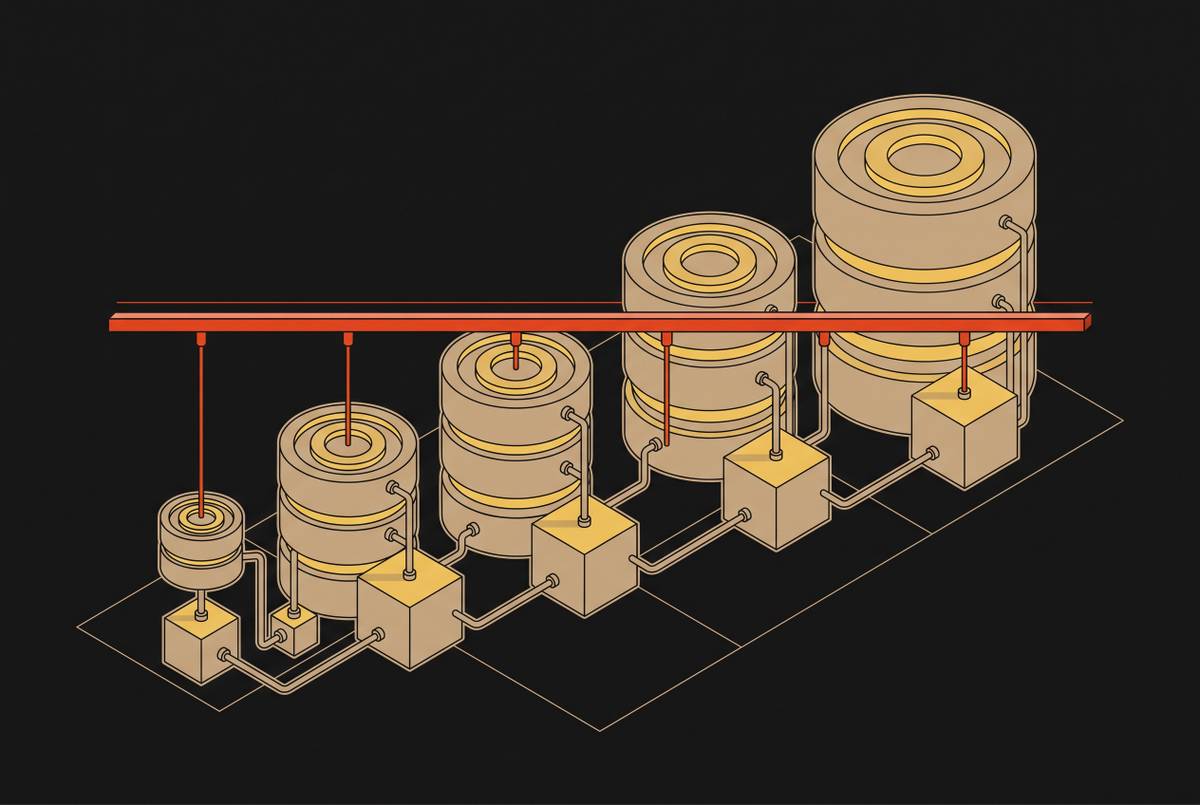
OLAP vs OLTP Workload Characteristics and Engine Selection
Row and columnar storage create irreversible trade-offs that no amount of tuning can overcome.
A table crosses a few hundred million rows. The fix isn't more hardware but the right engine for the job, since no amount of tuning changes that.
Why OLTP and OLAP represent genuinely opposite engineering trade-offs, not just different use cases
This plays out constantly across growing companies, and it points to something structural, not incidental. OLTP and OLAP aren't two flavors of the same database with different feature sets bolted on. They come from opposing storage decisions, and whatever makes one engine fast makes the other pathologically slow at that same task.
OLTP, short for online transaction processing, describes a workload: high volumes of short, concurrent reads and writes against current state. The guarantees matter as much as the speed. Full ACID compliance (atomicity, consistency, isolation, durability) is non-negotiable, and point-lookup latency needs to stay under a millisecond. The unit of work is one row, or a handful of them. Response time is measured in milliseconds. Query patterns are short and known ahead of time, so the query optimizer's job is to keep a plan stable under load, not to go hunting for the best plan on something it's never seen.
OLAP, online analytical processing, describes a different workload entirely: complex aggregations like sums, group-bys, and percentiles across large volumes of historical data. Schemas here tend to be wide and denormalized, because the optimizer's job shifts from plan stability to plan discovery across datasets that don't fit a known pattern.
Both terms describe workload characteristics, not specific products. A database vendor can build an engine that leans hard into one side or the other, but the mismatch between workload and engine is a physics problem, not a software quality problem. Force a transactional workload onto an analytical engine, or vice versa, and the degradation is the predictable consequence of the storage layout underneath.
How row-oriented and columnar storage layouts produce the performance gap at the I/O level
The gap gets created in that storage layout, through a specific mechanism worth making precise.
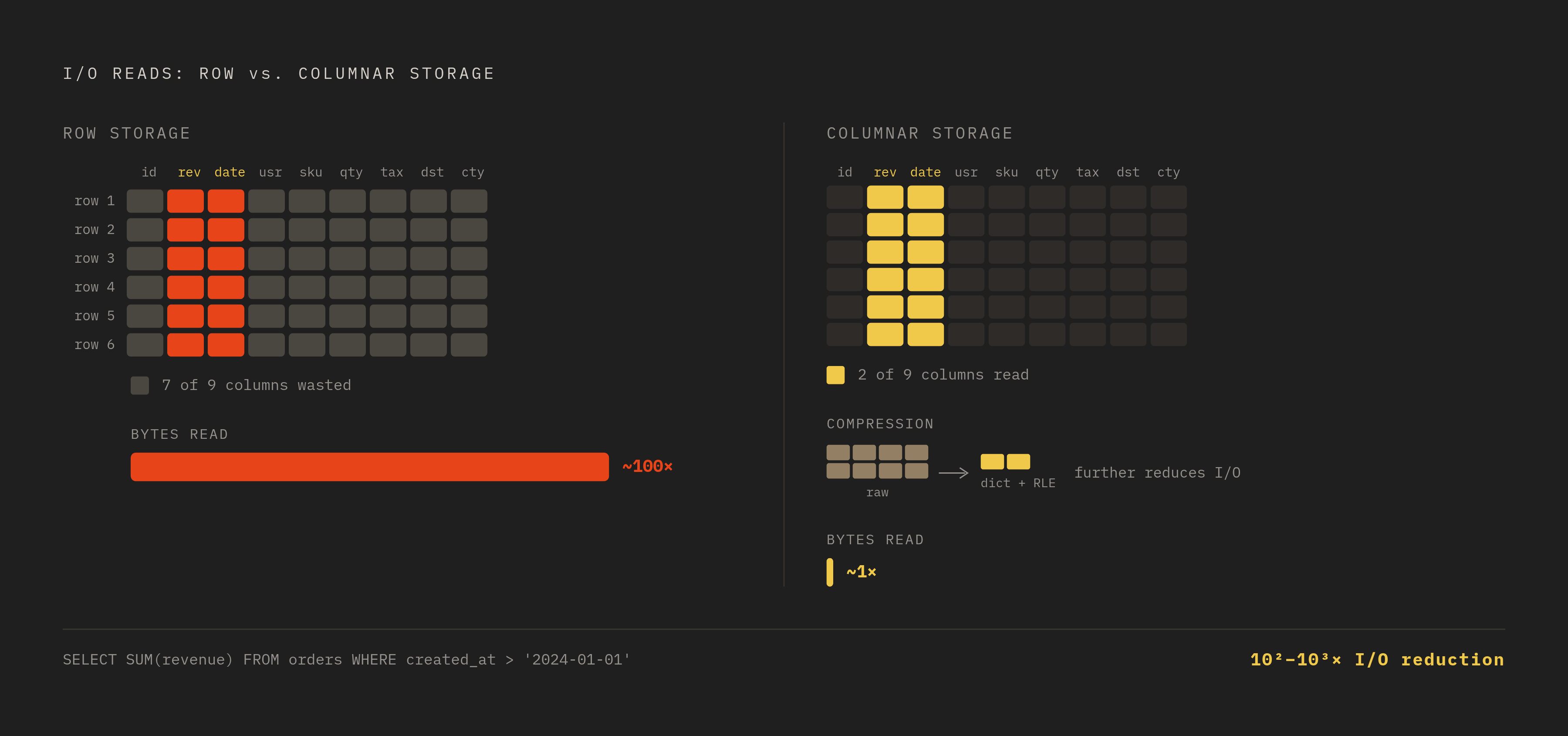
Row-oriented storage, the layout most OLTP engines use, keeps all the columns of a given row sitting adjacently on disk. A single read returns the whole entity in one pass, which makes point lookups and writes fast: inserting or updating one row touches one location on disk. That's exactly the access pattern a transactional system needs.
It's also exactly the wrong layout for analytics. Take a query like SELECT SUM(revenue) FROM orders WHERE created_at > '2024-01-01'. For a table with many columns and hundreds of millions of rows, the I/O difference between row and columnar access on a query like this can run two to three orders of magnitude.
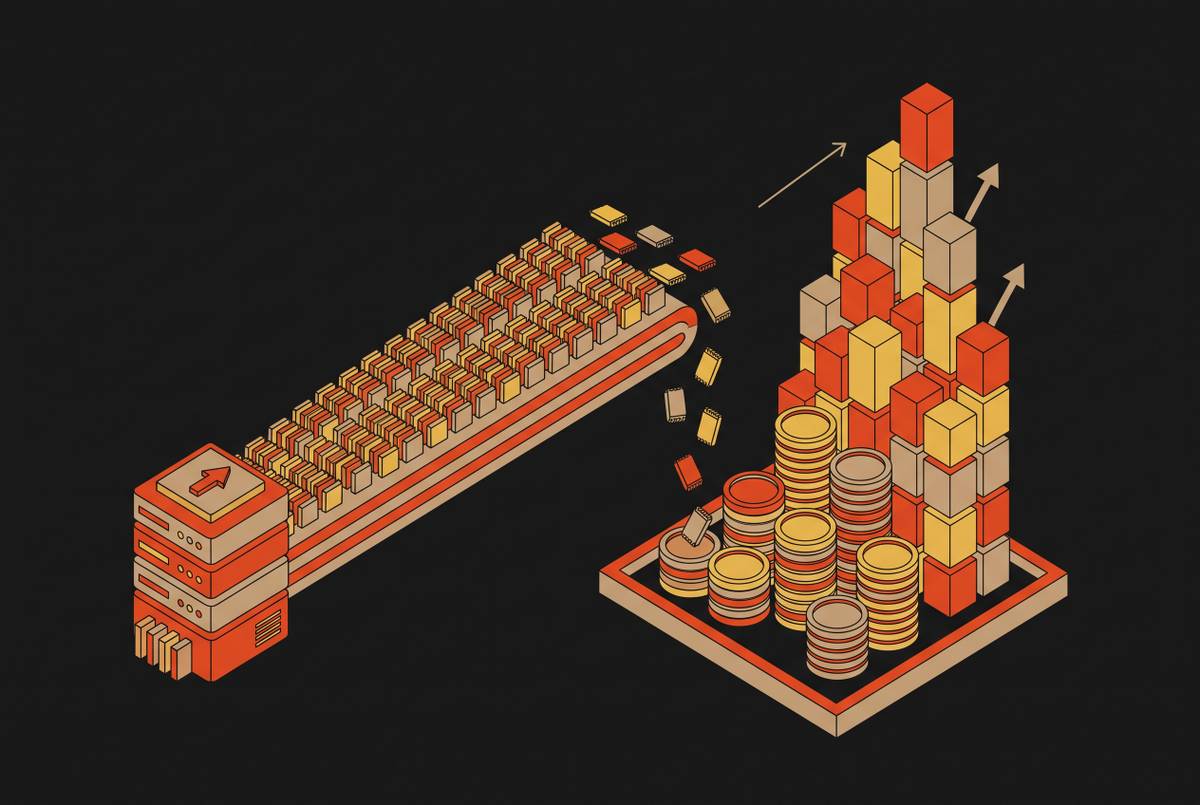
Columnar storage, the layout OLAP engines use, flips the arrangement: data gets stored column by column. If a query touches three columns out of eighty, it reads only those three. Values within a column also compress well, because every value in a column shares a data type and often has low cardinality, so encoding schemes like dictionary compression and run-length encoding work well. That compression isn't incidental. It compounds the I/O savings, because compressed data means fewer bytes need to move off disk.
OLAP engines layer several more techniques on top of columnar storage to get their performance: pre-aggregation and indexing of common rollups, massively parallel processing (MPP) that spreads a single query's work across many nodes, and query optimizers sophisticated enough to rewrite a query and shrink its scan range before execution even starts. Beyond that, partition pruning, bloom filters, and zone maps let the engine skip entire blocks of irrelevant data without reading them, and vectorized execution engines process data in batches using SIMD instructions, built for throughput over single-row latency.
None of that comes free. Row stores pay on scans. Column stores pay on writes.
The concurrency models diverge the same way the storage does. OLAP systems are built for parallelism within a single query, so they distribute one complex aggregation across many CPU cores or nodes at once. Run many concurrent OLAP-style queries against a system designed for that second pattern, and resources get exhausted fast. The concurrency model that's safe on an OLTP system is dangerous on an OLAP one, and the reverse holds too.
OLTP systems typically keep a buffer hit ratio above 99 percent, because hot data is small and fits comfortably in memory. The architectural difference between row and columnar storage is why engine selection can't be a retrofit: a system built to minimize I/O on point lookups degrades predictably as analytical query volume and data size both grow. A real-time analytics platform that needs to serve complex aggregations at scale, without latency creeping up as terabytes accumulate, needs a columnar engine built for that access pattern from the start. Services like ObsessionDB are designed to remove the trade-off between growing data volume and flat query latency, by separating compute from storage and keeping hot analytical data in a distributed cache mesh instead of routing every query through object storage like S3.
What schema design choices look like when the engine is columnar and the workload is analytical
Engineers who learned schema design on OLTP systems tend to carry that training into analytical projects, and the instinct usually misfires. Normalization was the right call on a row store, because it prevented update anomalies under concurrent writes. On a columnar engine running analytical queries, that same instinct toward aggressive normalization, particularly snowflaking dimension tables out of a fact table, usually buys very little.
Dimension tables are small relative to the fact table in most analytical schemas, so the storage saved by snowflaking them is marginal. A wide, denormalized star schema, by contrast, doesn't cost what it would on a row store. Reading five columns out of eighty on a columnar engine costs roughly the same as reading five columns out of five, because the engine only scans the columns the query actually touches. Columnar engines read just the columns a query needs and process them in batches through SIMD-friendly loops, so flattening dimensions into the fact table doesn't penalize queries that never touch those dimensions.
Pre-aggregation follows the same logic: totals, averages, and counts that get queried often can be precomputed or indexed ahead of time, which speeds up the common analytical workloads substantially. That same pre-aggregation would be a maintenance headache on a table being written to constantly, which is why it never made sense on the OLTP side.
Filtering matters too, but you don't need a deep dive into query planning to see why. Modern OLAP optimizers combine column pruning, reading only the columns a query touches, with predicate pushdown, applying filters at the storage layer before data ever gets pulled into memory for aggregation. A schema that makes predicate pushdown clean and direct is as important to design for as normalization decisions ever were on the transactional side.
Many modern OLAP systems also separate storage from compute entirely, so they can scale elastically and use resources better. OLAP databases built for multidimensional analysis, across axes like time, geography, product, and user segment, perform best when those dimensions are explicit and directly filterable in the schema, rather than buried several joins deep in a normalized chain of foreign keys.
Taken together, these design patterns, denormalization as a feature rather than an anomaly, wide fact tables, pre-aggregation as standard practice, and an optimizer whose job is discovering the plan that minimizes scan range, compound the I/O and latency advantages columnar storage already provides. Choosing the engine comes first. The schema gets designed around it, not the other way around.
Where the OLTP/OLAP boundary blurs
User-facing dashboards and operational analytics have complicated the clean split described above. Analytics used to mean a handful of analysts querying yesterday's data in a batch job. Now a product team wants a usage chart for every customer, a fraud score computed on every transaction, and a leaderboard that updates as events arrive.
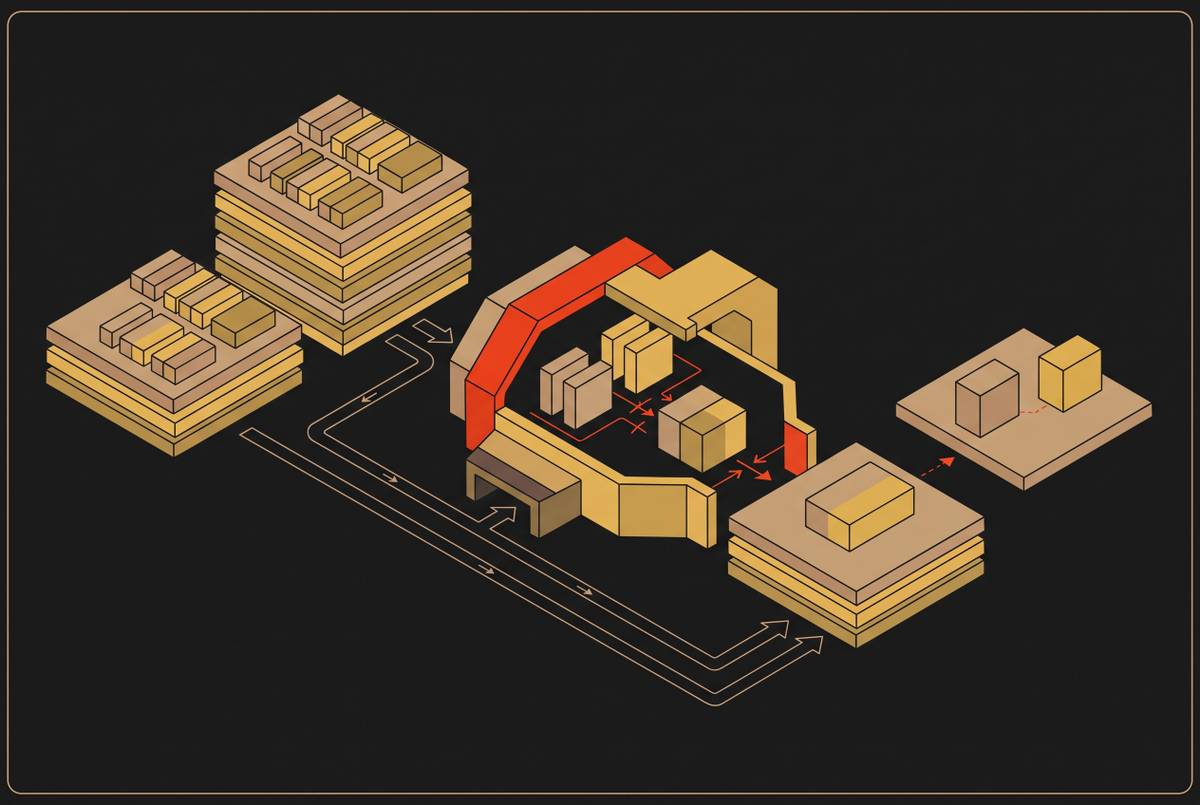
Freshness requirements drive most of this pressure. Teams want the number on a dashboard to reflect a transaction that committed moments ago, and nightly ETL simply can't deliver that. What this pressure produced, across the industry, wasn't an attempt to collapse OLTP and OLAP into a single box. It was change data capture: a pipeline that tails a transactional database's write-ahead log and streams every insert, update, and delete into the analytical store within seconds, replacing the overnight batch job. CDC reads the transaction log directly and emits each row-level change as an event, so the downstream analytical system stays in sync without re-querying or batch-exporting the source. Managed connectors have made this close to turnkey for most teams building it today.
The gap between OLTP and OLAP appears most clearly in user-facing analytics. The query pattern, scan and aggregate, is analytical. But the concurrency and latency profile, thousands of simultaneous users expecting sub-second responses on fresh data, is transactional. Neither category, on its own, describes the requirement.
HTAP engines (hybrid transactional-analytical processing) take a direct run at this problem by serving both workloads from a single store, and the appeal is obvious: one system, one operational surface, less to manage. The compromises are real too. What goes up is operational simplicity, because one engine now owns both jobs that two engines used to split.
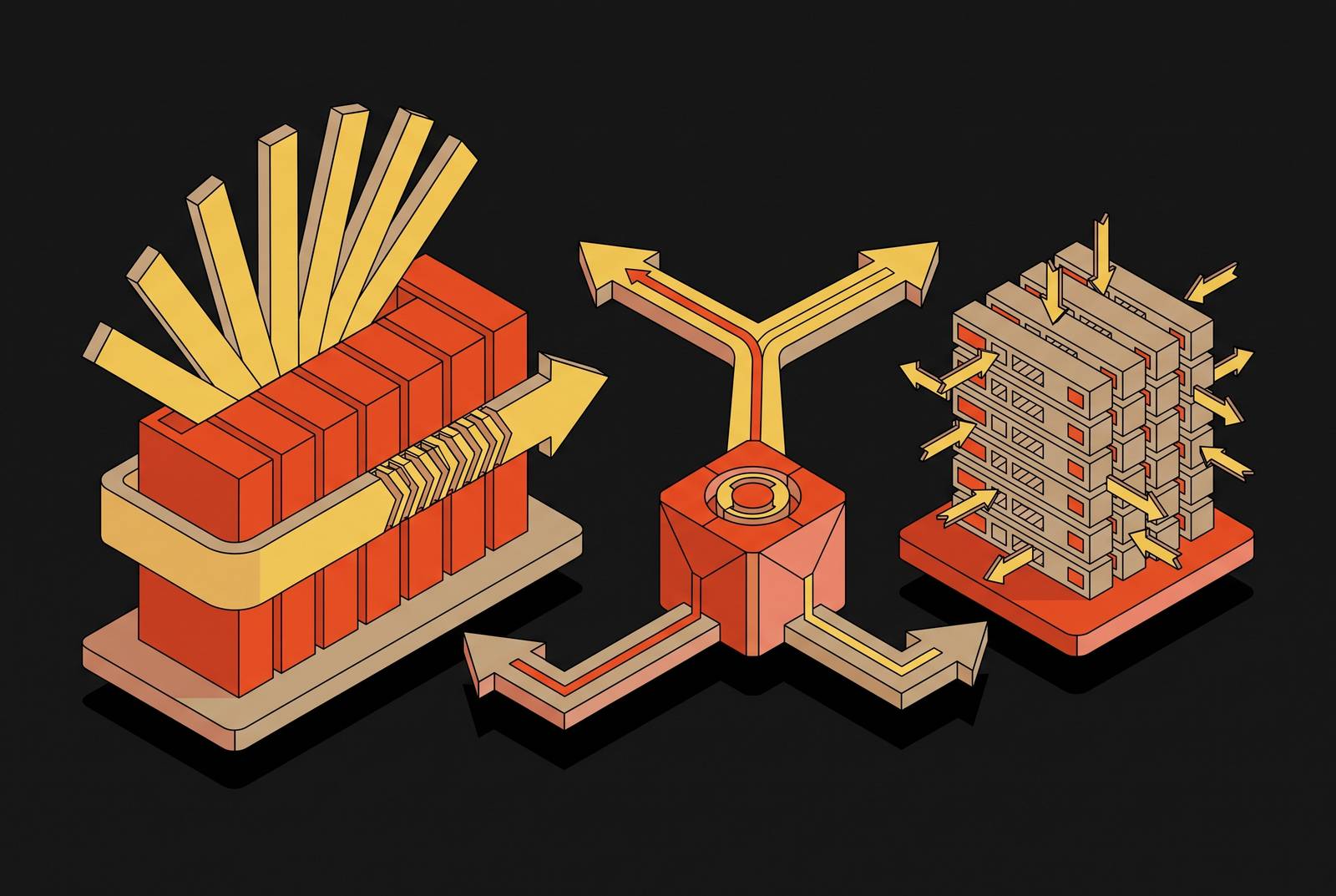
Most production teams, weighing that trade, land on keeping two purpose-built engines and connecting them with CDC. A transactional database handles writes. A CDC pipeline streams every change into the analytical store within seconds. The analytical side gets to keep its columnar storage, its MPP, its vectorized execution, everything that makes it fast at scale, while the transactional side keeps its row-oriented storage and ACID guarantees intact. The mismatch described at the start of this piece, analytical queries degrading a transactional engine, isn't theoretical. Understanding that the storage layout determines the concurrency model, and the concurrency model determines which workloads run fast and which run pathologically slow, is what keeps that mismatch from turning into a six-figure migration later.
Running both engines and connecting them with CDC is the default architecture going into 2026, because the replication connecting them got cheaper and more continuous than it was when these two categories were first defined.
How to select an engine architecture based on access pattern, concurrency profile, and freshness requirement
Selecting an engine comes down to three questions: what's the access pattern, what's the concurrency profile, and how fresh does the data need to be. The answers map cleanly onto a small set of architectures.
Choose an OLTP database when the system's primary job is processing transactions, order entry, account management, inventory updates, anything recording the state of the business as it changes in real time. The requirements that follow from that: low-latency single-row reads and writes, full ACID guarantees, and concurrency control that holds up under thousands of simultaneous sessions without buckling. Query patterns stay short and known ahead of time, so the optimizer's job is plan stability, not plan discovery. These systems need to run around the clock with continuous backup and recovery in place, because any downtime or data loss hits business operations directly.
Choose an OLAP database when the system's primary job is answering analytical questions across historical data, BI dashboards, ad-hoc analysis, ML feature pipelines, executive reporting. The requirements: fast aggregation over millions or billions of rows, predictable performance on wide scans, and a concurrency pattern dominated by long-running reads. Modern OLAP databases aren't passive warehouses anymore either. Many support both batch and real-time ingestion, and they integrate directly with data lakes, lakehouses, and streaming systems.
Reach for the two-engine CDC pattern when freshness requirements are in the single-digit-seconds range and analytical concurrency is high. That's the production default most teams land on today, and for good reason: it lets each engine keep doing what it was built to do.
For the strictest cases, sub-second SLAs on massive, real-time event streams where data is mutable (late-arriving records, deduplication, session correction all need handling), a general-purpose warehouse often isn't built for that profile. That calls for an engine purpose-built around it specifically.
A read replica of an OLTP system shares its source's storage layout, so it is still not an OLAP engine, a mismatch that's common enough to name directly. It shares the same row-oriented storage layout as its source, and it will degrade under the same analytical query load the primary would, no matter how much hardware sits behind it.
A newer category of workload is forcing this framework to get sharper still: AI agents that probe data relentlessly and in parallel. An OLTP system isn't built to absorb that. A warehouse priced per query penalizes this pattern structurally: the more an agent asks, the more it charges. Agents need isolated, read-only compute over shared data, full logging of every query for auditability, and sandboxed branches, so they can experiment against real data without touching production. These are architectural requirements for the workload. ObsessionDB's architecture was built with that pattern in mind: agents get isolated read-only compute, every query gets logged in full, and compute pricing stays flat on a monthly basis rather than penalizing a workload for asking more questions.
The engine question is about matching the physical storage layout and concurrency model to the actual shape of the workload, before data volume grows large enough to make the wrong choice expensive to undo.