Shadow Traffic Routing for Observability Pipeline Validation
Validate pipeline changes with real data before production promotion.
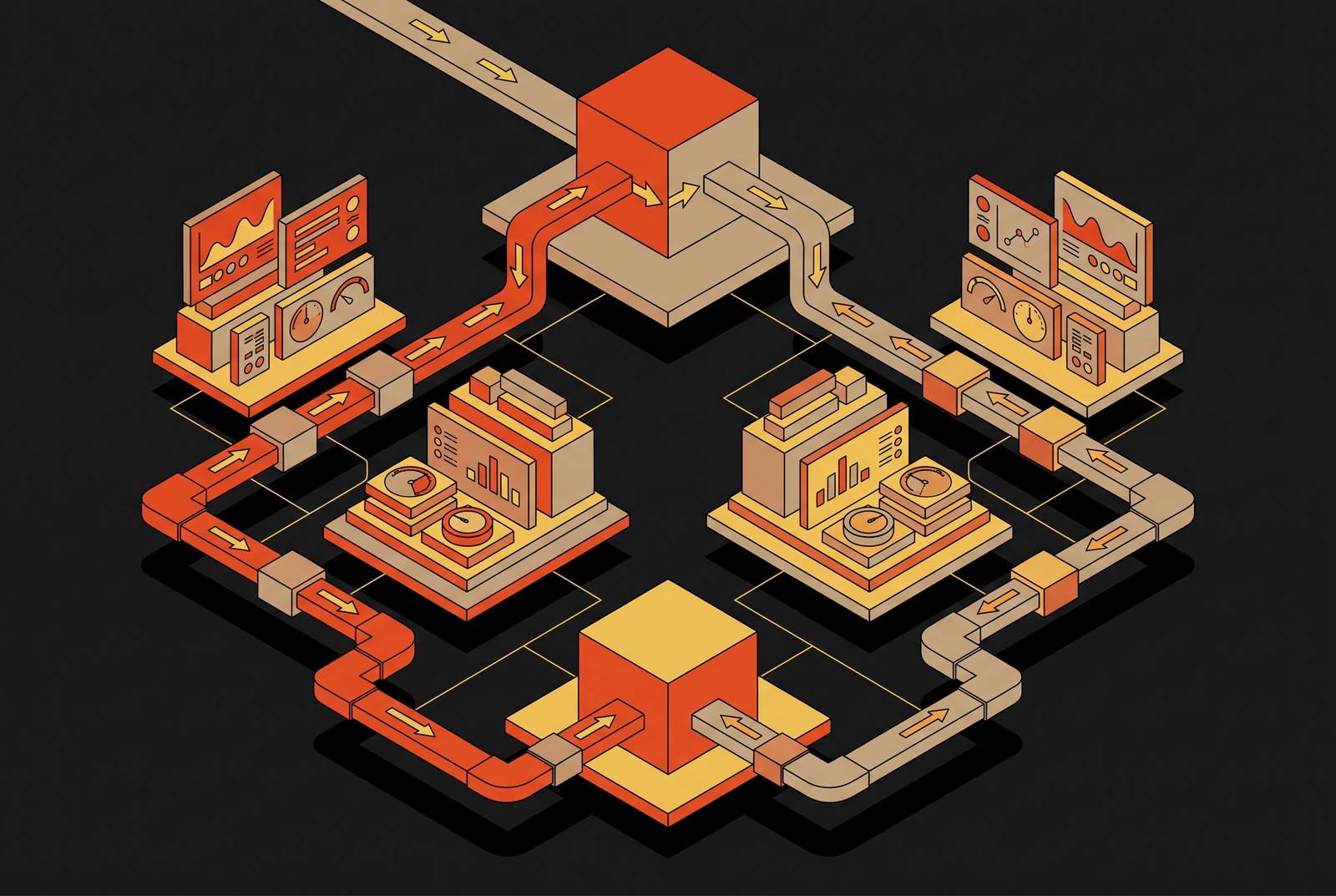
Shadow traffic routing validates observability pipeline changes by sending live telemetry to a candidate while production continues unchanged. It shows how a change behaves with real data shapes, cardinality, and timing, which staging cannot show. That evidence becomes reliable only when the shadow path is isolated, the comparisons are meaningful, and promotion depends on explicit pass criteria.
Why staging environments cannot validate observability pipeline changes
The usual staging assumption is that a change which works against representative test data is ready for production. For observability pipelines, the word representative carries more weight than it can bear. Synthetic tests follow predefined paths, while production brings bursts, malformed requests, long-tail payloads, and timing collisions. Staging data is also cleaner and smaller, hiding skew, high cardinality, and field-type variance. Simpler caches, network paths, and downstream latency conceal resource contention and retry amplification.
These gaps matter because a pipeline failure can damage the evidence needed to detect other failures. A renamed column can break downstream joins, while an event count recast from INTEGER to STRING can corrupt aggregates. A dropped primary-key constraint can let duplicate records reach dashboards. None of these requires an obvious outage. Staging can establish that a configuration works on its test data, but it cannot establish that production telemetry will survive it intact.
What shadow traffic routing is and what it is not
Shadow routing duplicates live telemetry to a candidate pipeline while the production pipeline continues handling the original stream. The candidate processes its copy in parallel, and its output is logged and compared. Its responses are discarded, leaving production state unchanged. Asynchronous processing keeps the candidate’s response time off the production path. That separation is the defining boundary of the pattern.
Canary testing crosses that boundary by exposing real consumers to the candidate. Shadow asks whether the candidate behaves reasonably on the real distribution, while canary asks whether it performs well with real users in the loop. Fan-out differs for another reason, because every destination is relied upon. Load testing answers a different question again, using synthetic traffic to stress capacity. These distinctions determine how failures must be handled.
Configuring the OpenTelemetry Collector to duplicate telemetry to a shadow backend
The OpenTelemetry Collector supports this pattern through exporters with different reliability settings. The receiver accepts OTLP over gRPC on port 4317 and HTTP on port 4318. The shared processors are memory_limiter and batch/production. Each service pipeline for traces, metrics, and logs has both otlp/production and otlp/shadow in its exporters array.
The production exporter has retries enabled with exponential backoff, a sending queue of 10,000, and ten consumers. The shadow exporter instead sets retry_on_failure to enabled: false, uses a queue of 500 with two consumers, and sets block_on_overflow: false. If the candidate falls behind, the shadow exporter drops batches rather than blocking or consuming unbounded collector resources.
The small queue also makes an important limit visible. Shadow results describe the data that reached the candidate, so dropped batches matter to the evaluation even when they are the correct operational response. The run should therefore be a bounded comparison window, with the shadow exporter removed when evaluation is complete. For Kubernetes deployments, Istio traffic mirroring offers an infrastructure-layer alternative. Istio, Envoy, and GoReplay provide routes to duplication without application code changes.
What the shadow pipeline reveals that staging never surfaces
Once duplication is running, the useful question is what would make the candidate unsafe to promote. For a schema migration, a renamed field may pass staging because the test data was generated after the rename. Live telemetry still carrying the old name exposes the mismatch. An INTEGER-to-STRING change becomes visible in downstream aggregates, while duplicate event IDs reveal the effect of a dropped constraint. The comparison needs to check the data that comes out as well as whether ingestion completed.
Collector changes require a different focus, including dropped batches, throughput, backpressure, and latency under bursts. Backend swaps add ingestion latency, query latency, high-cardinality write errors, and storage cost. Production p99 latency over a one-minute window cannot be compared fairly with shadow p99 over five minutes. Identical definitions and measurement windows are prerequisites for interpreting any apparent improvement.
The silent-failure problem: monitoring the shadow pipeline itself
The duplication layer can stop forwarding traffic while Kubernetes reports both deployments healthy and production continues normally. A shadow pod may return 200 from its health check even when it has received zero requests for hours. Because production remains unaffected, ordinary production alerts need not fire. The resulting comparison dataset may be truncated or empty without anyone noticing.
The missing check belongs at the duplication layer. Instrument a counter for requests forwarded to shadow, and alert when that count stays at zero beyond a defined interval. Log shadow failures explicitly rather than swallowing exceptions in the duplication path. Then confirm that production and shadow have the same instrumentation granularity, because unequal visibility can make a functioning comparison misleading.
Operationalizing shadow routing for schema migrations, collector config changes, and backend swaps
For schema migrations, send production telemetry into the candidate schema and compare parse failures, null rates on new or renamed fields, and type-coercion errors. Use full traffic volume because rare field variants are often exactly what breaks. The promotion gate is zero shadow parse errors across a representative peak-and-off-peak window, with field null rates within tolerance of the production baseline. For high-cardinality analytical backends, the window should also cover a full cardinality cycle. A single day of data cannot capture dimension values that change with the week.
For collector changes, the gate shifts from field correctness to delivery behavior. Check whether adding processors or changing the configuration drops more batches than production does during real bursts. Sampling-rule tests need full traffic before the candidate rule applies, or the comparison starts with an already filtered dataset. For changes to batch-size and queue-depth, compare how latency is distributed, especially p99 under real concurrency. Define acceptable throughput, drop, and latency differences before the run rather than deciding afterward which regressions matter.
For backend swaps, apply advance pass/fail criteria to ingestion latency, query latency on identical workloads, high-cardinality write errors, and storage cost per GB ingested. This requires a longer window than a collector configuration test because measuring cost signals takes days, compared with minutes for the collector test. The test must also use as much data as production does. A backend that performs well on the first day may slow as data accumulates into hundreds of terabytes. Shadow evaluation can expose that latency growth in pure S3-routed designs and test the architectural benefit of separating hot-data caching from durable object storage, without making a vendor preference the verdict.
Sampling strategy and comparison scoring: keeping shadow cost proportionate to validation confidence
Full-volume shadow traffic should not become an indefinite default. The better model matches each comparison’s cost to the coverage it needs. Duplicated telemetry storage is inexpensive relative to evaluating every pair, so reducing ingestion is not the only cost lever. Schema and format checks are cheap enough to run on 100% of shadow traffic. They also need that coverage because field-presence and type-compliance failures may be rare.
Latency and throughput comparisons can use a statistical sample large enough to characterize p99 with confidence. The right sample rate depends on how much traffic there is and the desired confidence interval, so one percentage will not fit every test. Cross-pipeline comparisons of event shapes can also be sampled, with stratification by service and event type to represent long-tail variants. This tiered principle transfers from AI evaluation, where semantic comparisons and LLM-as-judge checks have different costs. Observability validation has different checks and thresholds, so an AI evaluation score needs to change before it can be used here.
Schema migrations still need full traffic, and sampling-rule changes still need the unfiltered stream before the new rule runs. Couple a scheduled evaluator to shadow ingestion from day one so stored data produces decisions. Evaluate each change against its predefined gates instead of allowing a broad score to obscure a failed check. Only after shadow passes those gates should canary expose real consumers to the candidate in a controlled, non-zero way.
Agentic workloads as a shadow routing use case: when the pipeline consumer is an AI agent
When an AI agent consumes pipeline data, a missing field can corrupt decision context. Agents probe in parallel and can expose concurrency and cardinality patterns that human-driven dashboards do not trigger. They may also depend on exact field names and types. An agent expecting an integer event count may fail silently or misroute a decision when it receives a string.
MCP’s Resources primitive lets the application control access to specific data sources, each identified by an address. A request for a production table’s current schema or a config file’s contents expects exact data. OpenTelemetry’s MCP span attributes provide trace enrichment for correlating agent tool calls with the pipeline state behind their inputs. During shadow evaluation, check that these MCP-layer traces remain coherent across the production and shadow boundary. Otherwise, a candidate can appear usable while weakening the evidence needed to explain an agent’s action.
Auditability is part of that contract. Log every agent query in full, and check that the candidate’s agent-access logging works before promotion. Compute that is isolated and read-only lets agents probe the candidate’s results over shared data without changing production state. Sandboxed branches keep those experimental queries from contaminating the production dataset used for comparison. The goal is to validate both the information an agent receives and the record that makes its use accountable.
The operational checklist for running shadow routing in production
Before the window opens, configure the shadow exporter with retries off, a small queue, and drop-on-overflow behavior. Keep the settings that make production delivery reliable, and use the shadow settings only for the shadow destination. Instrument the forwarded-request counter and set the zero-traffic alert interval. Connect automated comparison to ingestion, align metric definitions and windows, and write the promotion criteria before results arrive.
During the window, run schema and format checks on 100% of shadow traffic from the first batch. Compare p50, p95, p99, error rate, and throughput on a defined cadence. Keep the run open through the traffic cycle the change needs to cover, including peak and off-peak periods or the days it takes for the change to produce measurable backend cost signals. Log every shadow failure, and take dropped shadow data into account when judging how much the test covered.
Preserve the comparison inputs and document the dataset in the change record so the decision can be reproduced. Once the candidate is promoted, remove the shadow exporter from the collector pipeline configuration. Archive the comparison dataset with the change record for post-incident reference.