Total Cost of Ownership for High-Volume OLAP Query Fleets
Architectural choices, not headline pricing, determine what high-volume OLAP queries actually cost.
The monthly bill shows up and it doesn't match the model. Engineers priced the migration on list rates, it looked reasonable, and the first invoice lands two or three times higher than the spreadsheet said. The instinct is to negotiate a discount. The problem is usually architectural.
Why headline compute pricing is the wrong number to optimize for in OLAP fleets
The sticker price of an OLAP engine is a poor predictor of what a high-volume query fleet actually costs. The dominant cost levers sit in the architecture, not in the tariff. Teams migrating off Postgres, or evaluating warehouses for the first time, default to comparing per-credit or per-query list prices. That frame obscures the structural differences between billing models, caching strategies, and storage access patterns.
MotherDuck's OLAP decision guide identifies TCO and architectural efficiency, not raw scale, as the primary evaluation lens teams should use. The reason is straightforward: list-price comparisons miss the structural differences that determine what you actually pay. MotherDuck's 2026 columnar database guide makes the same point more sharply. Cloud warehouse compute and scan-based pricing "can heavily penalize data-volume growth and drain engineering budgets" in ways that list prices do not signal.
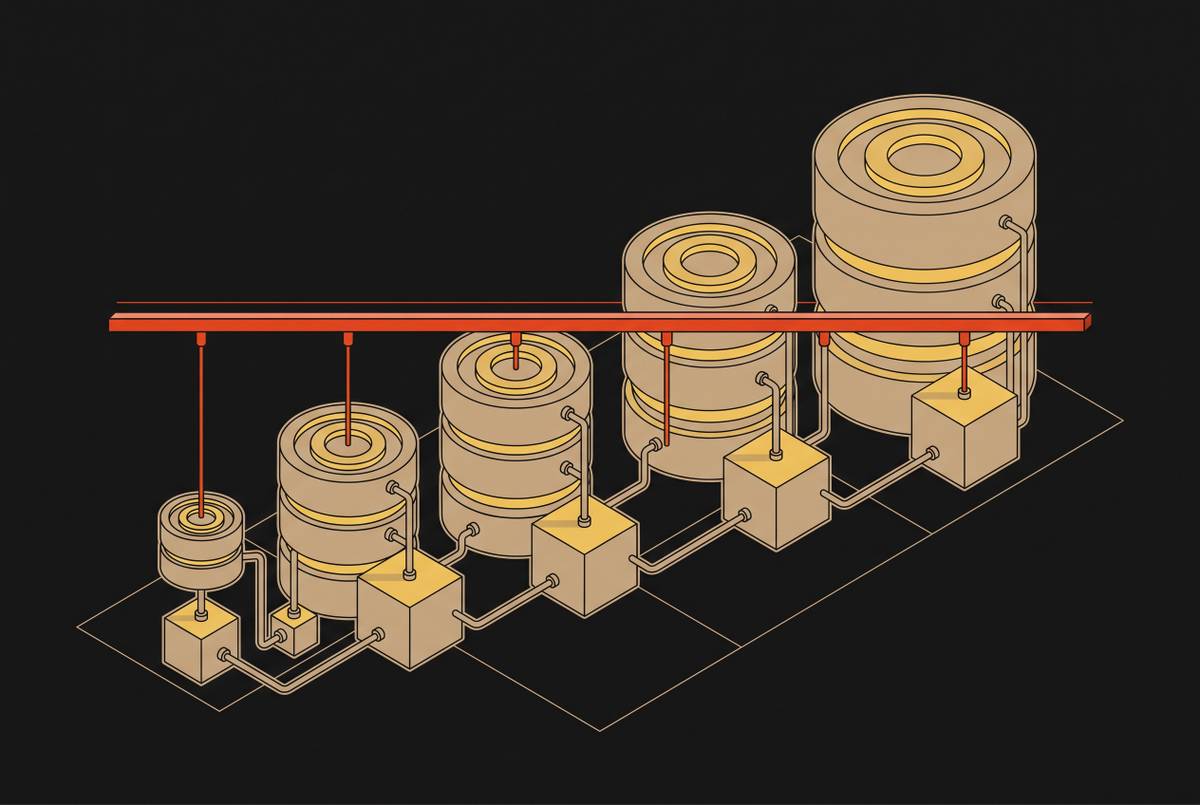
For high-volume OLAP fleets, TCO is determined by a cascade of architectural decisions. Billing granularity. Cache placement. Storage access path. Cost-volume scaling. These compound each other and remain largely invisible until the bill arrives. The market context makes this urgent: the OLAP Database Systems market is expected to grow at a compound annual growth rate of 8.9% from 2026 to 2034. More teams will hit this problem, not fewer. The sections that follow examine each cost lever in turn, what it does to a high-volume fleet, and how to model it before you commit.
How billing granularity silently multiplies cost for frequent, short queries
Scale-out warehouses enforce a minimum billing increment per cluster runtime. A query that completes in under a second is billed as a full unit of cluster time. That may sound trivial on a single query. It stops being trivial when you multiply it across thousands of daily queries.
For high-volume fleets, the mismatch between actual query duration and minimum billing increments is a structural tax that compounds directly with query frequency. The more a fleet queries, the worse the unit economics get. This is the core mechanism. A sub-second dashboard refresh billed as a full minute of cluster time adds no value. It simply charges you for time you didn't use. Fine-grained, per-second billing architectures align cost to actual work performed and keep unit costs flat as query frequency rises. MotherDuck's 2026 real-time analytics guide notes that billing per second produces more predictable costs for high-frequency workloads.
The strongest objection is that minimum billing increments affect only short queries. Heavy analytical workloads run long enough that the minimum is never binding. That's true for long-running batch jobs. It misses how mixed most high-volume fleets actually are. Interactive dashboard queries, point lookups, and aggregations dominate by count even when batch jobs dominate by duration. The minimum bites on the majority of queries.
Per-query pricing is a related but distinct problem. Any model that charges per query rather than for compute capacity penalizes high-curiosity workloads. Human analysts asking many small questions pay more for the same insight. Agentic workloads amplify this dramatically, which we'll return to. The architectural point stands on its own: how you are billed shapes what you pay far more than the headline rate.
What happens to cost when every query touches object storage
Architectures that route every query through object storage appear cheap at rest. The durable store costs very little per gigabyte. But that same architecture becomes expensive and slow in motion. Per-query S3 scan costs accumulate rapidly at fleet scale, and the latency floor of object storage makes sub-second response times structurally impossible.
S3 scan pricing is additive with query frequency in a way that compute pricing is not. Each query incurs a scan cost proportional to the data touched, regardless of whether the same data was scanned a moment ago. Hot data, the recent time windows, the dimension tables, the high-cardinality keys, gets paid for repeatedly, every time it is touched. A dashboard that refreshes the same last 24 hours of data every minute across a hundred users is paying for that scan a hundred times a minute.
Caching hot data in memory or on fast local storage eliminates repeated S3 scan costs for the data queries hit most. The cache absorbs the majority of query volume while S3 remains the durable, cheap store for cold data. ObsessionDB's cache-mesh architecture operationalizes this directly: hot data stays on local NVMe, queries never route through S3, and S3 is used only for durability, not as the query path. The result is that p99 latency stays flat as data volumes grow, because the latency-sensitive path does not touch the high-latency storage tier.
The hidden ETL cost of proprietary format ingestion compounds the storage problem. Loading data into a warehouse's proprietary format before it can be queried adds pipeline cost and latency that never appears in compute pricing. MotherDuck's 2026 columnar guide identifies ETL overhead as a structural cost that modern architectures address through in-place querying of open formats like Parquet, avoiding the format-conversion tax entirely. The storage access path matters twice: once for what you pay to scan, once for what you pay to load before you can scan at all.
How cost scales as data volumes grow: the volume-sensitivity problem
In architectures where cost is a function of data scanned or stored in proprietary formats, data volume growth is a direct cost multiplier. This is not a manageable operational concern. It is a structural guarantee that the bill grows faster than the business value delivered.
Scan-billed architectures charge proportionally to data touched per query. As datasets grow, even well-structured queries scan more rows. Cost per query rises automatically without any change in query patterns. MotherDuck's 2026 columnar guide calls out the need to model the cost impact of data volume growth, specifically a 10× growth scenario, as a required input to a rigorous TCO analysis, not an afterthought. Teams that model only current-volume costs systematically underestimate what they will pay in 18 months.
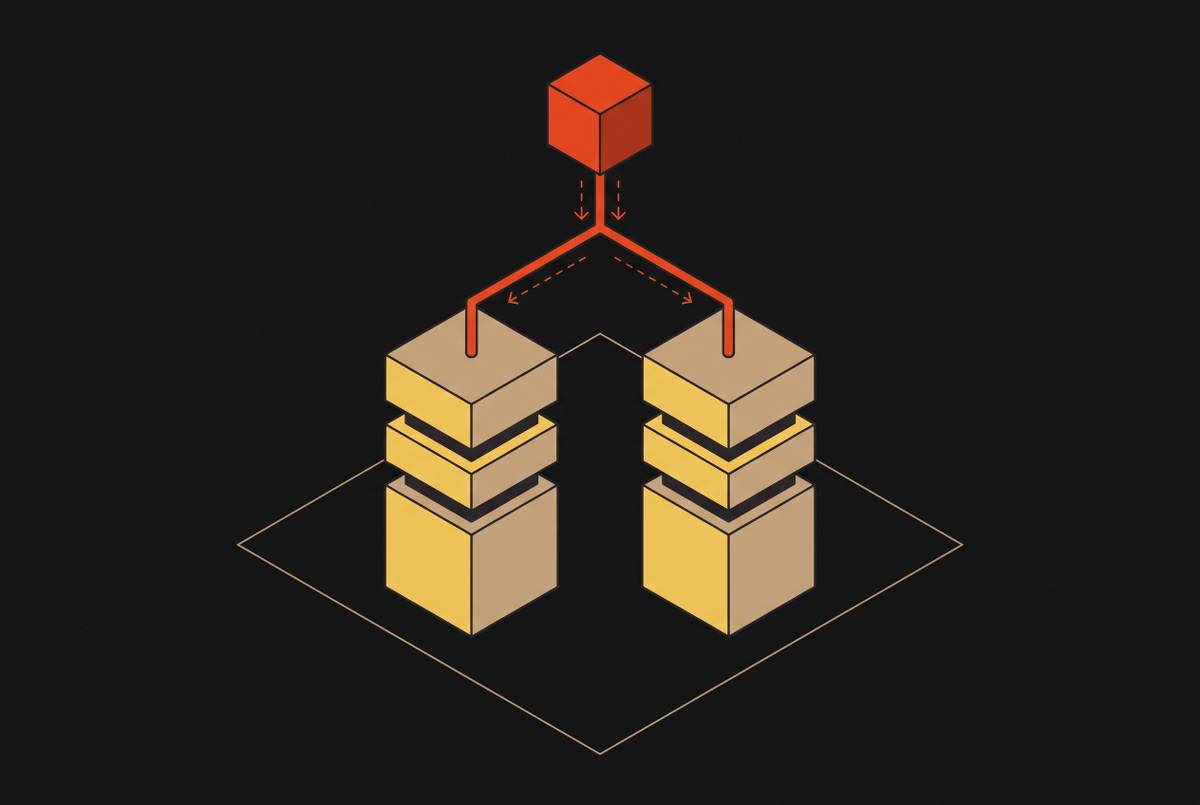
Separation of compute from storage decouples the cost of storing data from the cost of querying it. Cold object storage holds everything at object-storage prices. A fast cache or local storage layer handles active queries. Storage costs grow linearly with data. Query costs grow only with query activity, not dataset size. ObsessionDB's architecture makes this separation explicit: S3 for durability at S3 prices, NVMe cache mesh for query performance. Data volume growth adds storage cost but does not raise per-query compute cost. Query latency can increase for data that exceeds the NVMe cache, but the cost per query stays structurally flat.
Committed discounts and reserved capacity deals can partially offset volume-driven cost growth. That is worth acknowledging. But the enterprise discount gap between list price and actual spend introduces planning risk of its own. Teams that budget on list prices may overpay before negotiating and underprice their services after. The variance between list price and actual enterprise spend at scale can be substantial. This underscores why architectural efficiency, not discount negotiation, should be the primary TCO lever. A discount adjusts the absolute level. Architecture determines how cost scales.
Why idle compute is a cost that high-volume fleets cannot dismiss
Cluster-based architectures charge for provisioned capacity even when no queries are running. That converts the natural ebb and flow of analytical workloads into a steady cost floor that has nothing to do with the work actually done. A high-volume fleet is rarely uniformly busy. Dashboards have traffic spikes. Batch jobs run on schedules. Interactive users have off-hours. The gap between peak provisioning and average utilization represents compute paid for but not used. MotherDuck's 2026 columnar guide identifies idle compute costs as a required line item in rigorous TCO modeling, alongside ETL costs, data volume growth, and Parquet querying efficiency gains. MotherDuck's OLAP decision guide attributes "high minimum costs" partly to provisioned cluster architectures that charge for idle time.
Billing minimums and idle compute bookend the same problem. Billing minimums penalize you when queries are short. Idle compute penalizes you when queries are infrequent. Mixed workloads hit both. You pay for the floor when nothing runs, and you pay for the ceiling when queries finish early.
Serverless and scale-up architectures address idle compute by eliminating persistent cluster provisioning. Compute spins up for the query and does not accrue cost between queries. The trade-off is cold-start latency. Spinning up compute on demand introduces a latency floor that persistent clusters avoid. MotherDuck's customer-facing analytics guide acknowledges that MPP warehouses can suffer from cold-start latency, naming it a concrete production drawback for embedded use cases. The right choice depends on whether the workload values cost minimization or consistent sub-second response.
For high-QPS fleets where latency matters, keeping compute warm is operationally correct. But the architecture should ensure that warm compute is efficient, not merely persistent. ObsessionDB keeps compute available for active workloads without routing through S3 on every query, so warm compute translates directly to low latency rather than merely to availability. The question is never just whether compute is running. It's what the running compute is doing.
How AI agents make every one of these cost problems worse
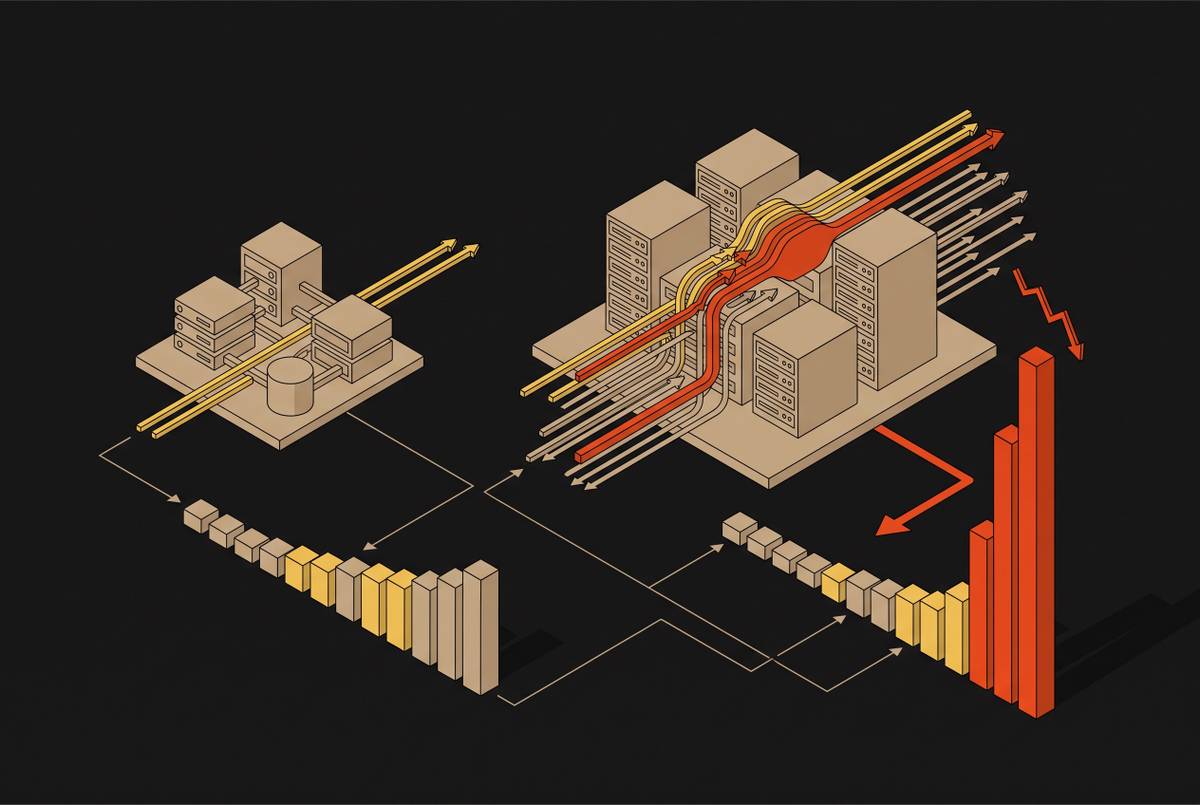
AI agents don't introduce new cost mechanisms. They amplify every existing one simultaneously. Agents issue short, frequent queries, hitting billing minimums repeatedly. They probe data relentlessly, maximizing scan costs. They operate continuously, erasing the idle periods that reduce average cluster cost. And they grow their query volume as the product scales, compounding the volume-sensitivity problem.
Agents retrieve context multiple times per second in some workloads. That far exceeds the query frequency of even heavy human dashboard users. The billing-minimum and per-query-pricing problems that are merely expensive for humans become architecturally prohibitive for agents. Established cloud warehouses with rigid billing minimums compound costs for the short, frequent queries agents generate in a way that compute-capacity pricing does not.
The academic research community has formalized agentic data access as a distinct systems challenge. A CIDR 2026 paper titled "Supporting Our AI Overlords: Redesigning Data Systems to be Agent-First," presented at CIDR 2026 in Santa Cruz, CA, explicitly addressed the need to redesign data systems for agent-first workloads. The engineering community recognizes this as unsolved infrastructure, not a configuration problem.
Security and auditability are cost-adjacent concerns that are uniquely acute for agent access. Agents issuing queries autonomously must be logged in full, and their access must be auditable. The operational cost of reconstructing what an agent did without adequate logging can far exceed the cost of building logging in from the start. ObsessionDB addresses this directly: agents get isolated, read-only compute over shared data, every query is logged in full, and sandboxed branches let agents experiment against real data without touching production. Auditability is architectural, not bolted on.
MCP, the Model Context Protocol, introduced in late 2024 and rapidly adopted, reaching tens of millions of monthly SDK downloads, has become the standard interface between AI models and external data sources including OLAP systems. This makes agent-to-database connectivity a production procurement decision. Teams evaluating OLAP infrastructure in 2026 must account for agent access patterns, not treat them as a future consideration. The market context is substantial: the global OLAP Database Systems market was valued at $28.5 billion in 2025.
What a rigorous OLAP TCO model actually needs to account for
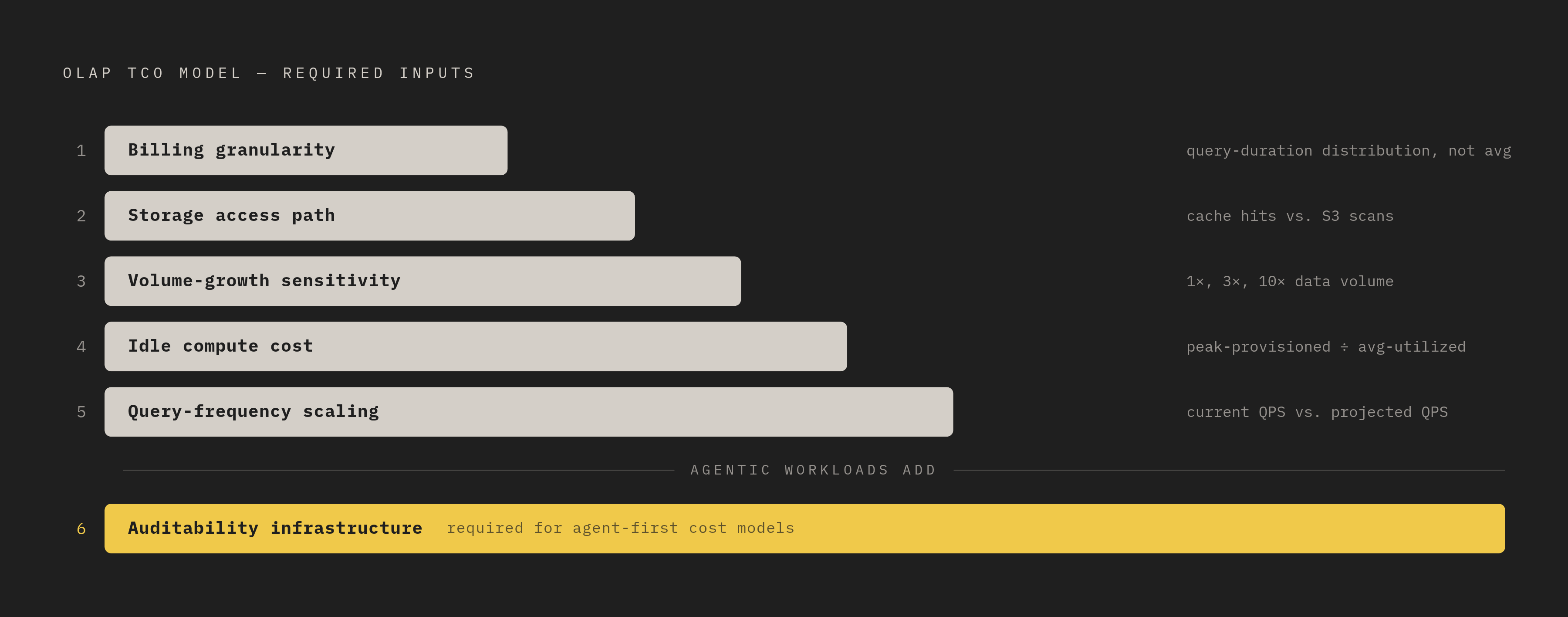
A defensible TCO model for a high-volume OLAP query fleet must account for at least five inputs that list-price comparisons omit. Billing granularity. Storage access path cost. Volume-growth sensitivity. Idle compute cost. Query-frequency scaling. For agentic workloads, add auditability infrastructure as a sixth.
Billing granularity means modeling the actual distribution of query durations in the fleet, not just average query time. Minimum billing increments are irrelevant for long queries and dominant for short ones. Most fleets are short-query-heavy by count. Benchmark data should be compared on identical workloads at identical query frequencies. Any benchmark that does not disclose query duration distribution is hiding the variable that most affects billing-minimum impact.
Storage access path means modeling the cost of hot-data queries hitting object storage versus cache, and the cost of repeated scans of the same data windows. Whether to cache hot data is an architectural decision worth quantifying as a line item, not leaving as an assumption. ETL ingestion cost into proprietary formats should be included as a pipeline cost, not omitted because it sits outside the query engine's billing.
Volume-growth sensitivity means modeling cost at current volume, at 3× volume, and at 10× volume. If the cost curve is superlinear, that is an architectural signal, not just a forecasting input. MotherDuck's 2026 columnar guide explicitly identifies the cost impact of 10× data volume growth as something a true TCO model must account for.
Idle compute means estimating the ratio of peak-provisioned compute to average-utilized compute. The gap is the cost of standing capacity. A serverless architecture eliminates this line item but introduces cold-start latency that must be evaluated against SLO requirements.
Query-frequency scaling means modeling cost at current QPS and at projected QPS. If query volume is expected to grow through product growth, additional users, or agentic workloads, this matters. Per-query-billed and minimum-billed architectures scale cost with query frequency. Compute-capacity pricing does not.
ObsessionDB is designed with each of these levers in mind. Compute-hour pricing removes per-query cost scaling. The NVMe cache mesh eliminates repeated S3 scan cost for hot data. Compute-storage separation decouples storage growth from query cost. Full query logging makes agentic workloads auditable without additional infrastructure. The global OLAP Database Systems market is projected to expand to $54.2 billion by 2034. The teams that win that growth will be the ones whose cost models survive contact with their own architecture.
Benchmark transparency matters most of all. Any TCO comparison between OLAP options should specify query duration distribution, QPS, data volume, and caching configuration. Comparisons that omit these parameters are marketing, not benchmarks. The list price tells you almost nothing. The architecture tells you everything.