Why Batch Ingestion Into a Vector Index Breaks Real-Time RAG Guarantees
Stale vector indexes silently serve outdated answers to current queries.
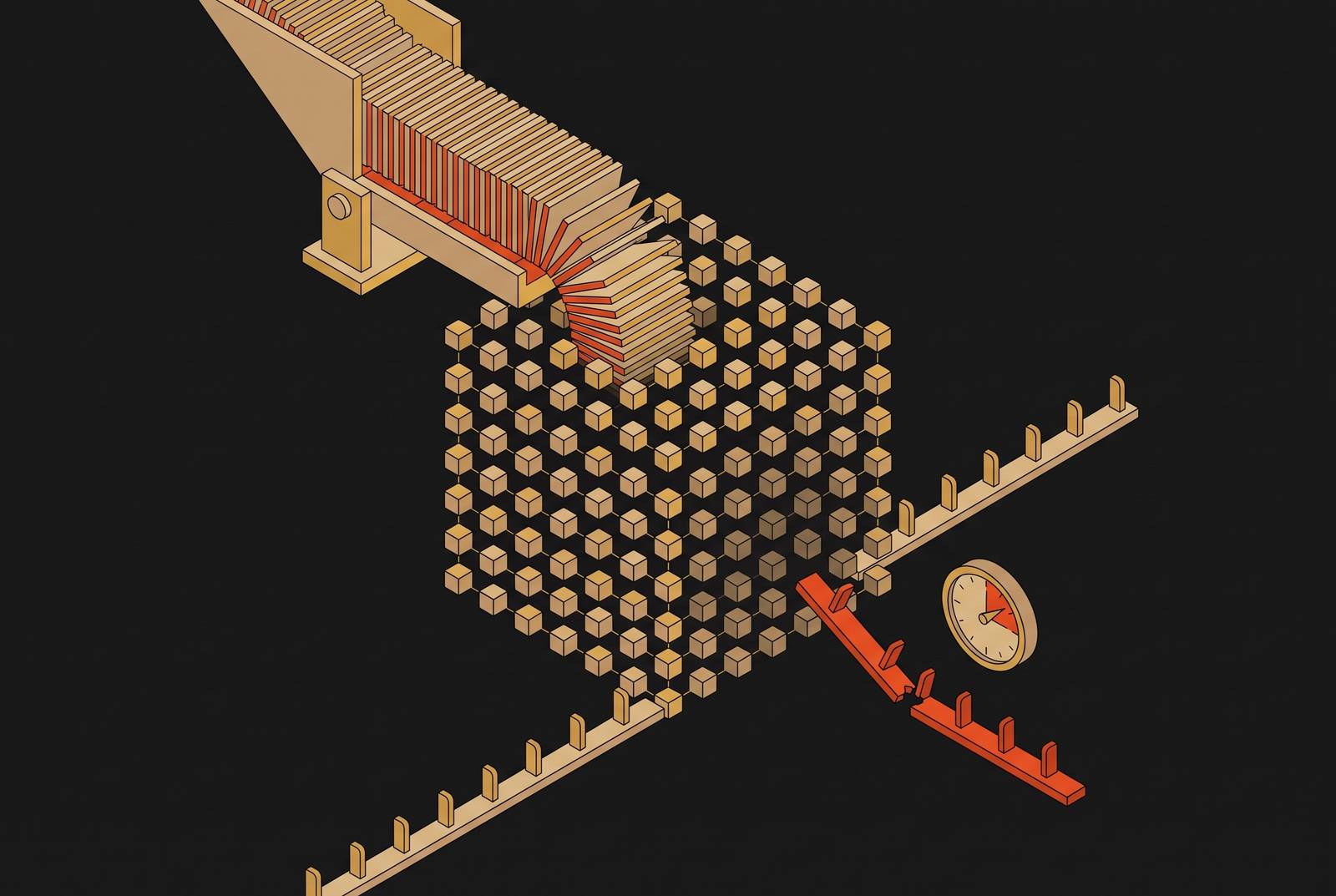
Batch ingestion into a vector index breaks real-time RAG guarantees when users expect current knowledge but retrieval serves the last indexed snapshot. Outdated context can pass every check in the pipeline and become a confident answer. Freshness therefore needs an explicit architectural contract, supported by change handling, retrieval-level observability, and an audit trail.
The implicit freshness contract that RAG systems make — and cannot keep with batch ingestion
A critical refund policy changes mid-afternoon, but the next indexing run is at midnight. For the rest of that business day, support queries that retrieve the policy receive its old terms. The assistant still answers promptly and fluently. Nothing in that response tells the reader that the source has changed.
What did the user reasonably expect? Choosing retrieval over static prompts or fine-tuning suggests that answers will draw on the knowledge base as it stands at query time. That is the implicit freshness contract. Yet a real-time query interface says nothing about when its context was ingested. Without a freshness signal, the user and a downstream agent have no way to tell whether they should question how current the answer is.
What the vector index actually is — a point-in-time snapshot that ages silently
A vector index stores representations computed during ingestion and has no live connection to what is true in each source document. Embeddings are written once and stay as they are until another operation replaces, appends, or removes them. Between batch runs, the index has no awareness of source changes. Its contents are a point-in-time snapshot, even though queries run against them continuously.
A document embedded months ago can have a high cosine similarity score while describing something that is no longer true. A superseded policy, closed support ticket, or deprecated authentication flow can therefore remain a strong match for a current question. Low query latency and high availability cannot tell those documents apart from ones that are current.
How the staleness gap compounds across three dimensions as corpus size and update rate grow
The first dimension is the freshness window, which is the time between a source change and its arrival in the index. Nightly ingestion allows up to 24 hours of stale context per update cycle. Each change exposes queries retrieving the affected document to its pre-change version throughout that interval.
The second dimension is accumulation rate. A small corpus with sub-hour re-indexing may stay fresh enough, while the same approach with hundreds of thousands of documents can leave multi-hour or multi-day windows. If re-indexing does not scale proportionally, the proportion of stale documents can grow. More changes then have to wait as each processing cycle takes longer. Full nightly re-indexing also incurs embedding API costs for the whole corpus, even for documents that have not changed, so running it more often costs more as the corpus grows.
The third dimension is the detection void. Standard RAG evaluation measures faithfulness, context recall, context precision, and answer relevancy against documents that it treats as still true. A faithfulness score near 1.0 means claims trace to retrieved context whose continued accuracy remains unverified. A golden evaluation dataset built when documents were fresh can keep passing as they age.
The four document lifecycle events that batch ingestion handles incorrectly, and what each one produces
An update creates a silent version conflict. Until the next run, the source has changed but the index retains the old document. Where old and new versions coexist, cosine similarity chooses between them without guaranteeing that the newer version wins. When pricing, policies, and API documentation change quickly, retrieval can therefore return a mix of old and new versions as it moves between them.
Deletion produces an orphan. A document disappears from the source while its vectors remain retrievable, allowing the model to use content that no longer exists there. In HNSW-based indexes, tombstoning leaves dead nodes traversable during search but filtered from results, and an increasing deleted-to-live ratio degrades recall and latency. Rebuilds or compaction are typically needed after substantial accumulation, though modern systems may use local graph repair. GDPR and right-to-erasure requirements also make deletion a compliance obligation.
Creation leaves a different kind of gap. A new document is available in the source system but absent from the vector index until ingestion runs. Queries must work from the pre-creation corpus. They may retrieve a less relevant older document, or the model may hallucinate an answer where useful context should have been available.
An embedding model upgrade can fail more quietly still. The vectors already in the index stay the same unless they are explicitly re-embedded. Vectors from model version A and model version B may have the same dimensionality but occupy disjoint semantic spaces, so nearest-neighbor search across them can return wrong neighbors without an error. Nothing has to crash for precision to degrade. Evaluation built around one model generation may also miss the problem across portions of the index that have not been re-embedded.
Why the failure is confident misinformation, not a retrieval error the pipeline can catch
These failures are dangerous because retrieval can succeed. The embedding layer computed and stored valid vectors, and the retrieval layer returned the highest-scoring matches. The model then wrote clear prose based on those matches. Evaluation can approve that grounding, while the application returns the answer within its latency budget.
Where, then, would the warning come from? None of those checks establishes whether the retrieved fact is still true. Faithfulness can even make the failure worse by rewarding an answer that closely follows context that is out of date. The model has no native sense of when that context became invalid. Its fluent explanation presents an old fact in the same voice as a current one.
A stale report may invite questions about its date, but generated prose need not reveal its age. The user receives an answer with its ingestion history hidden. For an agent, that answer can become an action, including submitting a refund at an old rate, routing a ticket to a deprecated queue, or validating against a superseded policy. Without context-age logging, the record can show what the agent did while leaving the stale basis for its decision invisible.
The strongest case for keeping batch ingestion — and where it actually holds
Batch is the right tool for some knowledge bases. When content rarely changes and freshness windows of 12–24 hours are acceptable, continuous ingestion may add work to keep the system running without making the answer more useful. Archival content and legal document search can fit this pattern where their freshness requirements allow it.
Batch also offers a consistency advantage. A full re-index followed by an atomic swap provides a coherent index state that streaming incremental updates do not automatically provide. Very large corpora with low change rates may be more efficiently served by periodic full re-indexing than by streaming infrastructure built for a trickle of events. Streaming also exposes concurrent-write problems that batch implicitly serializes, including queue depth, lock wait time, and cross-writer conflicts.
These trade-offs support separate ingestion and query SLAs. Ingestion may legitimately operate over hours to days while queries must respond in seconds, because the pipelines have different responsibilities and failure modes. An ingestion allowance that conflicts with current-answer expectations for a changing knowledge base makes batch unsuitable.
What streaming ingestion changes architecturally, and what it does not automatically fix
With event-driven ingestion, document changes start the processing without waiting for a scheduled run. Change data capture, or CDC, captures creations and updates so the embedding pipeline works on just the documents that have changed. A typical path runs from a source database through a log reader such as Debezium, an event stream such as Kafka, a stream processor, and a vector store. This puts less load on the source and transfers less data than full-table batch extracts. Embedding costs follow the change rate, while changed documents can reach retrieval in seconds-to-minutes.
S3-backed object storage has a file-write interval that prevents sub-second freshness without a hot serving tier above it.
Streaming alone also leaves several problems unresolved. Model upgrades still require full re-embedding, and source format changes still require ingestion drift controls rather than continued use of an unsuitable chunking configuration. Concurrent writers need explicit conflict handling. Changes to chunking rules, embedding models, or classification policies require controlled, auditable replay across the full corpus while live ingestion continues. Most importantly, event-driven processing on its own does not show whether an answer used context that was current.
The observability and audit layer that makes freshness guarantees operational, not aspirational
Freshness observability begins with the documents a query actually retrieves. Document-level timestamps need to enter as metadata during ingestion and surface at retrieval time, where context age can qualify the answer. This requires a separate staleness detection layer. Faithfulness is still useful for checking whether generation followed its context, but it leaves open whether retrieval reached current ground truth.
Broker consumer lag tracks event consumption, leaving embedding arrival in the vector index, updated metadata filters, and retrieval cache invalidation unverified. Checks must cover the whole path to retrieval. Otherwise, a healthy stream can mask stale context at the point where the application uses it.
Every retrieval event should log the documents returned, their last source updates, and when their embeddings were computed. Those records connect a generated answer to the state of its evidence. For agentic workloads, full query logging is also needed to hold agents accountable, because a record of an action without its context age can explain only part of the decision. Sandboxed, isolated compute for agent retrieval, with access to current data and every query logged in full, provides an auditable operating pattern. Autonomy does not remove the need for a trace.
What teams need to architect around — the three decisions that determine whether freshness is structural or aspirational
The first decision is the freshness window the product actually requires. The use case determines that window independently of the engineering simplicity of batch. Nightly processing can be correct for archival corpora, while daily-changing knowledge bases with current-answer expectations call for streaming. That choice shapes how ingestion and serving must work and what they will cost. Without it, the system has no clear standard against which freshness can fail.
The second decision is whether ingestion is event-driven or schedule-driven, with its SLA explicitly separated from query performance. That choice includes both the serving path and the mechanism that launches embedding work. Sub-second retrieval freshness requires a hot serving tier above object storage. Streaming also needs replay safety for changes to chunking rules or embedding models, rather than an assumption that live ingestion is the only operating mode.
The third decision is whether freshness will be observed or merely assumed. Document-level timestamps and a detection layer separate from faithfulness metrics make staleness visible at retrieval time. For agents, full query logging and isolated read-only compute make stale-context failures traceable as well. The goal is not to eliminate every delay, which is impossible, but to make staleness detectable, logged, and alertable before it passes downstream as an error-free confident answer.