Why Query Auditability Is the Migration Gate for Autonomous Agents Touching Analytical Data
Agents need tamper-proof query records before touching analytical data.
Autonomous agents should not migrate onto analytical databases unless the database layer can capture, preserve, and attribute every query. Isolated compute limits interference, but full query auditability establishes accountability. The migration gate is whether the system can produce trustworthy evidence of what an agent did, for whom, and under what authority, starting with its first query.
Why agents query differently from humans, and why that gap breaks existing governance
Human operators usually access data intermittently, with relatively stable intent. An autonomous agent can exercise rights provisioned once continuously, around the clock, while moving through a task faster than a person can review its actions. That changes the window for intervention. An agent can access more data than its task requires, or correlate quasi-identifiers across tables, before a human reviewer has a chance to respond. The access may be technically permitted while still exceeding the purpose for which it was granted.
When one agent calls another, each may stay within its stated permissions while their combined processing violates a compliance requirement. Whose authority governs the combined result? A record that identifies only the individual callers cannot, by itself, explain whether the overall task was authorized. Governance built around one user or access event at a time struggles to account for actions whose significance becomes clear only across a chain of agents.
Monthly reviews and quarterly access audits can uncover past misuse, but they cannot catch an incident that ends at machine speed. More frequent reviews alone cannot resolve the treatment of permission to connect as an adequate account of permission to act. Attribution of who asked, why, and under what authority must exist before the query fires.
What auditability for agents actually requires, and why logs alone do not supply it
Auditability is the ability to answer a specific governance question about a specific decision from evidence actually captured. A log file is only a possible source of that evidence. Oleg Solozobov’s Decision Evidence Maturity Model for Agentic AI names the confusion between the two the “container fallacy.” The paper distinguishes the presence of an evidence container from the sufficiency of its contents, which requires checking each question and each property. A system can keep a great deal of telemetry and still lack the one field needed to show who was responsible.
Auditable Agents (2026) distinguishes accountability, auditability, and auditing. Accountability means being able to check compliance and say who is responsible, while auditability is the system property that makes this possible. Auditing is the process that uses that property. The paper argues that no agent system can be accountable without auditability and defines five dimensions, namely action recoverability, lifecycle coverage, policy checkability, responsibility attribution, and evidence integrity. Together, these dimensions ask whether the evidence can explain an action, cover its lifecycle, test its authority, identify responsibility, and withstand scrutiny.
Those questions set a concrete minimum for the record. Each agent query needs the human or system principal, the agent identity and version, the tool or query invoked, the arguments passed, the response returned, and a tamper-evident timestamp. A service account is not the authorizing principal. Likewise, an agent name without its version cannot show which deployment led to a change in behavior. Evidence integrity also requires an audit log that can be trusted, which rules out a record the agent can change.
Why application-layer logging cannot close the gap after the fact
The obvious objection is that applications already log their database calls. Why is another layer necessary? Application-layer logging that records queries after execution documents the application’s account of events, but cannot guarantee the integrity, completeness, or attribution of what reached the database. At agent speed, the interval between execution and the log write is already long enough for the consequential access to have occurred. A more detailed entry written afterward cannot turn that entry into a control that existed at access time.
Fragmentation further weakens the application’s account. SDKs, orchestration frameworks, and application services may each retain part of the interaction, without any single record establishing whether the overall task was authorized. This is the container fallacy at scale. If the application identifies callers through a service account shared across versions, tasks, and principals, attribution is lost before the log is written. Joining more records cannot bring back an authorizing identity that none of them recorded.
Application logs also remain modifiable by the systems that write them. Without tamper-evident records at the database layer, their integrity cannot simply be asserted to an auditor because the application was intended to behave correctly. Better application code can improve its own account, but it cannot substitute for evidence at the point of database execution. If the log cannot be trusted, the migration cannot be defended.
What MCP provides for auditability and what it structurally cannot
MCP gives agents a common protocol for connecting to tools and databases. It was designed for interoperability. Its Logging primitive was a diagnostic channel without integrity guarantees or retention semantics. The July 28, 2026 specification release deprecated that primitive under SEP-2577, along with Roots and Sampling, and set a twelve-month clock for their retirement. Its presence before deprecation did not establish audit sufficiency, and protocol compatibility does not establish it now.
Independent 2026 scans found thousands of MCP servers open to the public, many of them running without authentication. A callable tool is not necessarily a governed tool. Without authentication, an integration cannot establish which agent made a call for attribution, much less which principal was responsible for its task. This is an access-control gap before it becomes a question about the detail of a query log.
The gateway pattern responds by placing an MCP Gateway between agents and tools. It intercepts requests to centralize authentication, logging, and policy enforcement before forwarding them, so audit data passes through one control point. That is a real improvement over ungoverned MCP. However, the gateway remains a control plane above the database. It brings fragmented logging together, but evidence still needs to be captured and protected where the query runs.
The regulatory floor that makes auditability a migration prerequisite, not a post-launch project
An organization must be able to produce attributable evidence of what its agents did to meet applicable compliance requirements. Policy documents describe intended control. Where the rules that apply require evidence of access, that evidence must exist at the time of access. A post-launch project cannot supply an omitted principal or prove the integrity of a record that was writable. This turns the order of implementation into part of the compliance decision.
The EU AI Act became broadly applicable in August 2026, with full effect deferred to 2027–2028 for high-risk AI systems. Failure to meet its binding obligations can bring penalties that reach a large share of global annual turnover. For database access, the operative concern is provability. HIPAA Technical Safeguards also require more than a policy that says how data should be protected, and healthcare deployments that fail to comply face per-violation penalties. At agent speed, one misconfigured session can cause many violations before they are detected.
The U.S. Treasury’s Financial Services AI Risk Management Framework also emphasizes technical evidence, but it is voluntary guidance. That distinction prevents the frameworks from becoming an undifferentiated legal claim. The practical picture described in the brief is that 63% of organizations cannot enforce purpose limits on their agents, and a substantial share lack evidence-quality audit trails. Where binding requirements apply, launching without the required auditability creates exposure from the first query.
What does isolated compute with full query auditability look like for AI agents?
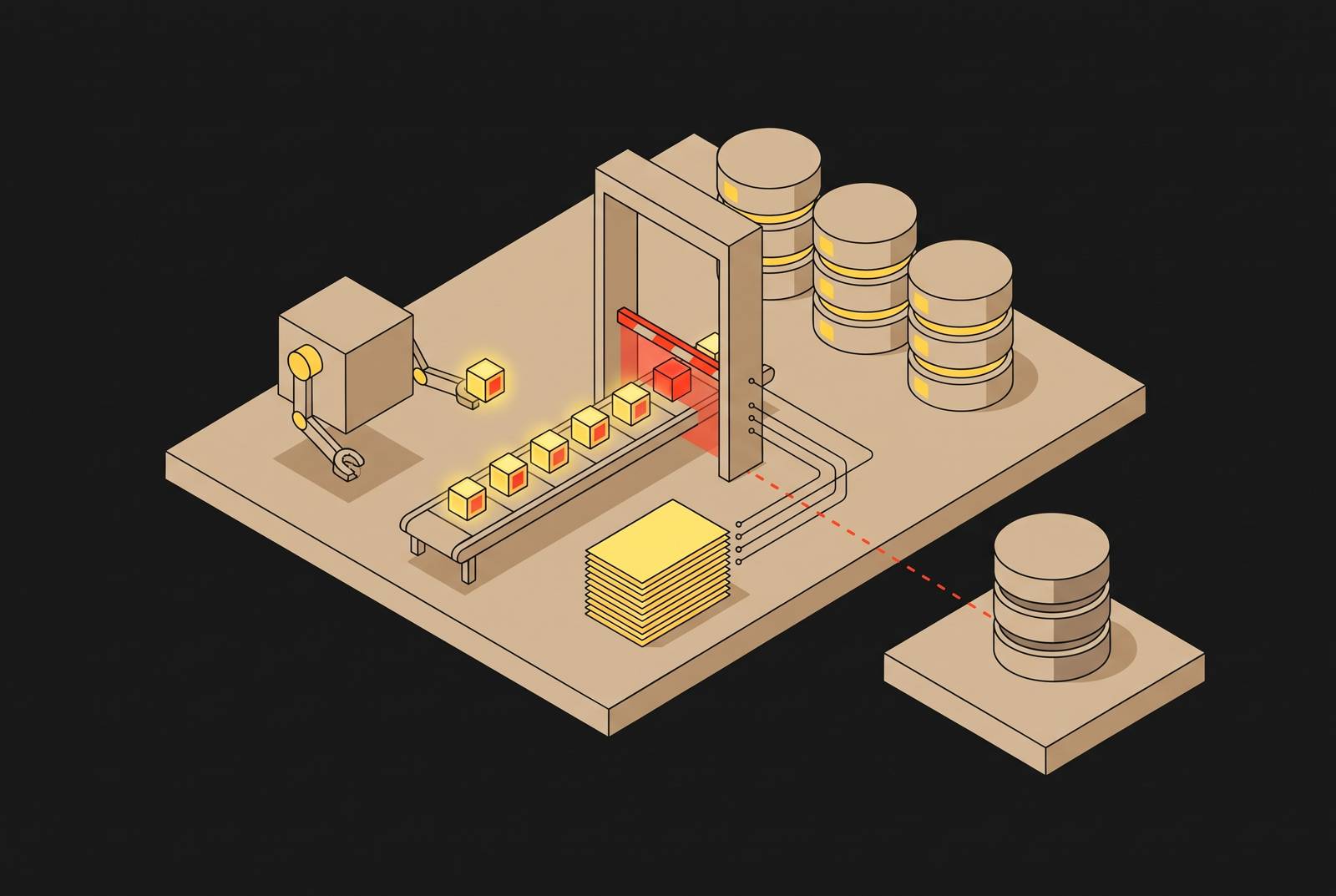
The architectural requirement begins at the database layer. It must capture and keep every query in tamper-evident records that show who was responsible, and cannot leave all of that work to an application wrapper or protocol gateway. Isolated, read-only compute provides the workload foundation. Separating agents from production writers removes the shared-compute interference and attribution ambiguity identified earlier. Isolation and logging serve different purposes, so neither is a substitute for the other.
Full query capture means no sampling or summaries. Each database record needs the agent identity, the principal under whose authority it acts, the exact query text, an invocation ID tying it to a specific tool call, and a timestamp that is tamper-evident to the agent. Those fields link the query that ran to the other evidence needed for arguments, responses, versions, and policy checks. Append-only storage can protect immutable event records from being overwritten by later agent activity. That protection does not create missing attribution, however, so identity fields and invocation IDs belong in the schema from day one.
Sandboxed branches add a controlled place for exploration. They let agents run exploratory and “what-if” queries against a point-in-time snapshot of real data without touching production. Supporting Our AI Overlords at CIDR’26 identifies the volume and inefficiency of agentic speculation as a challenge for data systems. Branches address that exploratory workload without sacrificing its audit trail. For schema and pipeline changes, schema-as-code tooling gives agents a path to describe, validate, and deploy versioned changes rather than issue ad-hoc DDL, making pre-authorized actions more auditable than free-form mutation.
Per-query pricing penalizes the high-frequency, short-duration probes that agents generate, so exploration becomes more expensive as the number of questions rises. Compute-hour pricing removes that particular penalty and makes comprehensive logging economically rational. It does not establish evidence integrity on its own. Its role is to support an architecture whose isolation, branches, versioned changes, and full records can remain practical under agent workloads.
How to assess whether a migration candidate database clears the auditability gate
A platform team should evaluate the target before granting production credentials. The test is not whether the product advertises logging, but whether its evidence answers the five auditability questions. Action recoverability asks whether the team can reconstruct the exact query, including all arguments, for any query within the retention window. Lifecycle coverage asks whether recording begins with the first query in an agent’s session. A warm-up or authentication phase excluded from the record leaves a gap that later completeness cannot repair.
Policy checkability asks whether the evidence can show that a specific access did or did not fall within the agent’s authorized scope when it occurred. This is different from showing that a policy exists today. Responsibility attribution then asks whether every record identifies the human or system principal that authorized the agent. Evidence integrity asks whether the agent and the dispatching application are prevented from modifying the audit log, with tamper-evidence that can be presented to an external auditor. Each question tests a different failure mode.
The migration sequence should follow those tests. The agent identity scheme, log schema with invocation IDs, read-only compute isolation, and branch environment need validation before agents receive production credentials. A candidate that fails any of the five tests does not clear the auditability gate for workloads subject to these requirements. Teams that build this evidence into migration design will be positioned to defend their deployments when regulators and auditors ask what happened.