Cutover Checklist for Moving a High-Volume Ingestion Pipeline Between Providers
A sequenced checklist turns high-risk pipeline moves into controlled operations.
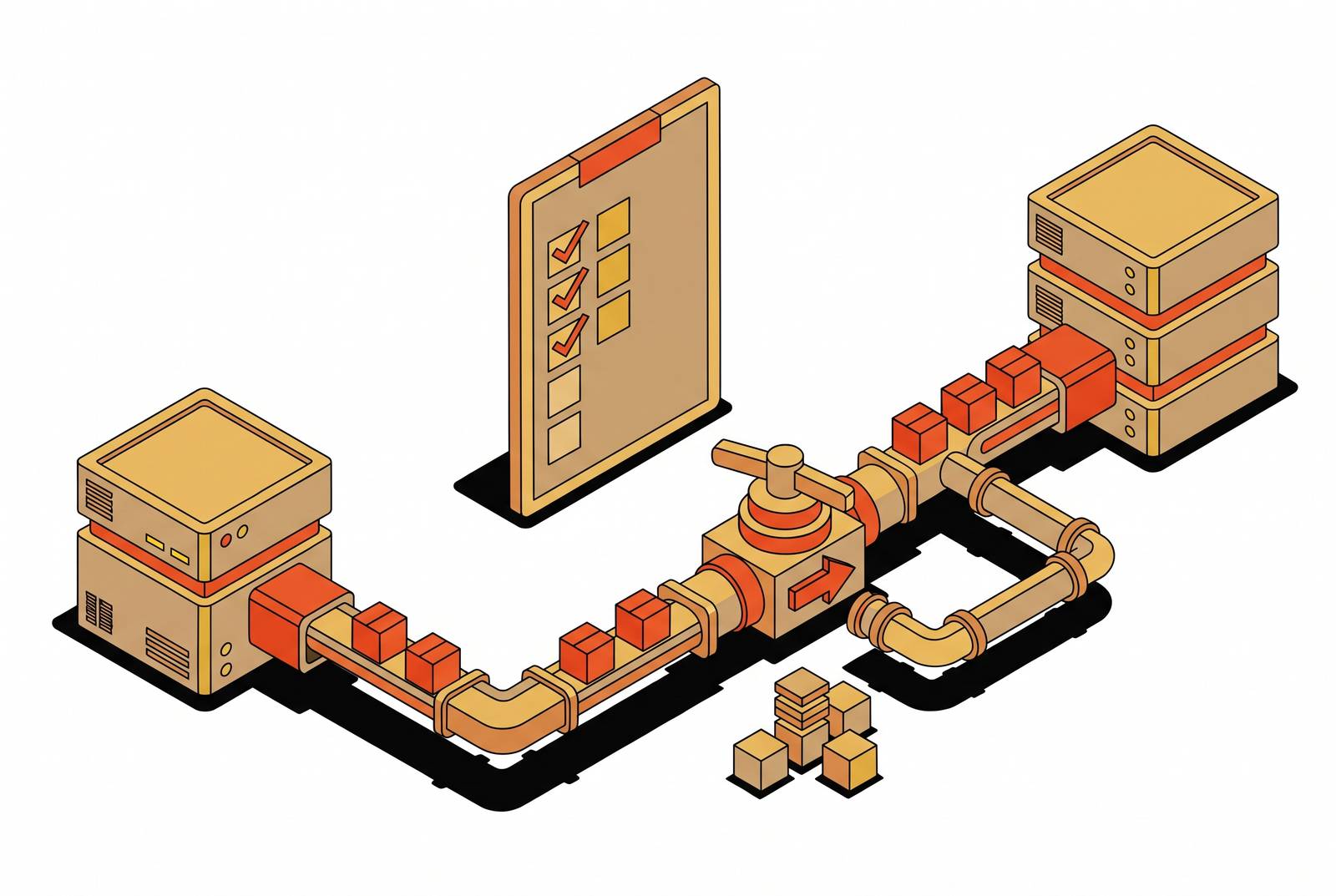
Moving a high-volume ingestion pipeline between providers is a sequenced engineering operation. The cutover checklist must therefore work as a series of gates, each closed with evidence before the next opens. Baseline capture, synchronization, validation, rehearsal, and rollback preparation make the highest-risk moment a controlled switch under live load.
Why high-volume ingestion migrations fail when treated as documentation exercises
A plan can name every task without proving that any task is complete. That gap creates two failure modes. An unrehearsed all-at-once move concentrates risk in a single event, while a phased migration without hard completion criteria merely spreads uncertainty across several events.
Matching row counts cannot establish that type mappings, renamed columns, cursor positions, log boundaries, or checkpoints are correct. If those problems surface only after routing changes, the team must investigate while the live pipeline is at risk. Moving existing fragility to another provider also preserves the engineering burden.
What to establish before any migration work begins — workload inventory, dependency mapping, and ownership assignment
Inventory every application, connection pool, worker, queue, ETL job, scheduler, integration, and administrative session that reads from or writes to the source. Assign each to a named person or team. Document inbound and outbound connections so that the move groups and their sequence follow actual dependencies. Flag BI tools, APIs, and real-time serving layers that cannot handle a rise in latency, even for a short time. Those constraints will shape the cutover approach.
Assign schema ownership before selecting migration tooling. The owner must explicitly resolve type mapping, column renames, new columns, and incompatible type changes. Locate cursors, log positions, retries, checkpoints, and replay boundaries, and document what can resume, what can replay, and how partial writes are detected. Classify each component as rehost, replatform, or refactor, keeping non-critical reporting separate from always-on ingestion where their needs differ. Nothing moves while ownership, dependencies, or success metrics remain unresolved.
Capturing a performance baseline that makes post-cutover regressions distinguishable from pre-existing problems
Record the baseline before migration work changes the source environment. Otherwise, how will the team distinguish a new regression from an existing problem? Record ingestion rate, error rate, replication lag, and query p99 across a representative window that includes peak load. Off-peak measurements cannot establish what the target must sustain. The baseline must describe the conditions under which the pipeline actually operates.
Record column types, nullability, encoding, partitioning keys, sort keys, and materialized views or downstream transforms that depend on physical layout. Capture the exact log position, offset, or cursor value at baseline time as a recovery anchor. Document current RPO and RTO, and confirm that a restore from the most recent backup has been tested. For point-in-time recovery, verify an unbroken log chain from the base backup to the desired recovery point. Store this evidence in a shared, version-controlled location.
Choosing the cutover approach — when all-at-once is forced and when phased is genuinely achievable
AWS Prescriptive Guidance frames cutover selection around dependent applications in the same move group, common data sources, partial-load routing, and latency constraints. For ingestion, the key questions concern the write path. Can the pipeline write to two destinations without duplicate or inconsistent downstream records? Can the source stay warm while the target takes live traffic? Can consumers tolerate the lag or inconsistency of a dual-write period?
An unsafe dual-write path, an impractical fallback because of license constraints, hostname conflicts, or cost, or a hard latency requirement can force all-at-once cutover. In that case, extensive performance and regression testing must replace the evidence a gradual ramp would provide. A nominal ability to split traffic is not enough if a real-time serving layer cannot tolerate the resulting behavior.
Phased cutover requires percentage-based routing through load balancer or DNS policy support, or an application-layer routing shim. It also requires the target to accept partial load and scale incrementally, which the dry run must test. Fast rollback through a routing reversal needs the source to stay live and up to date so there is no need to rebuild data. Where these conditions hold, start with non-critical or lower-volume workloads.
Setting up dual-write and running the initial load with a defined sync boundary
Take a consistent source snapshot at a log offset, LSN, or CDC boundary that has been recorded. That position defines the handoff. For large volumes, use a bulk-load path for historical records and a separate CDC stream for changes after the snapshot, then explicitly verify their shared boundary. Log-based CDC is a good fit when the pipeline needs close synchronization, hard deletes, or a way to avoid a long write freeze. Where timestamp cursors are used, account for backdated updates and clock skew with overlap windows and idempotent upserts where the source allows them.
Review every target column type, nullability constraint, and encoding against the baseline. Write down any renames and type changes made while loading. During synchronization, monitor replication lag continuously and compare target errors with source errors. If lag grows, the target cannot keep up with its current configuration, and if the target has a higher error rate, it fails the gate.
Keep agentic or high-curiosity validation queries on read-only compute so they do not compete with ingestion and distort the performance signal. Close this phase only with documented schema agreement, stable lag within the defined threshold, and error rates at or below the source baseline. All three conditions must be met before cutover can be scheduled.
The five validation layers that must pass before the cutover window opens
Layer 1 is completeness. Compare extracted, loaded, rejected, and filtered record counts between source and target against the expected counts recorded in the baseline. Any variance above the predefined threshold fails the gate.
Layer 2 is record fidelity. Run checksums and row-level comparisons across the full record population in the highest-risk tables. This finds changed values that comparisons of counts miss. Small per-row errors can accumulate into significant downstream impact.
Layer 3 is semantic integrity. Reconcile aggregate totals and referential relationships across the tables that feed downstream consumers. Correct counts on both sides of a join do not prove that the keys match correctly.
Layer 4 is functional behavior. Run critical queries, APIs, and application transactions against the target and compare results with the source. For real-time analytics, query p99 must stay within the baseline envelope. Give BI tools and dashboards their own validation workstream because a successful load does not prove they work.
Layer 5 is operational readiness. Check that backup and restore have been tested, lag and error rates are within limits, monitoring and alerting are active, and PITR log archives have no breaks from the base backup forward. Log every validation run with input and output counters, error buckets, and its timestamp. All five layers must pass before the window is scheduled.
The dry run — running the full cutover sequence at production volume before the real window
Schedule the dry run at least two weeks before production cutover and execute the full sequence at production volume. Time every task block explicitly. If loading or synchronization takes longer than the runbook allows, correct the maintenance-window calculation. Finding that mismatch during rehearsal is a success. If it turns up during the real window, the gate has failed to keep the operation safe.
The rehearsal must also exercise rollback by simulating a trigger and verifying that the team can return to the source within the documented rollback time budget. Record every step that requires judgment or escalation, then give it a predefined owner and decision criteria. Update the runbook with actual durations and corrected procedures, and obtain explicit sign-off from every team that must act. The gate remains open until those corrections are complete.
Arming the rollback before the cutover window opens — triggers, thresholds, and the rollback worksheet
Write down two triggers that must be acted on before the window opens. The hard stop is a specific clock time that initiates rollback if validation remains incomplete, regardless of apparent progress. The data error threshold is an agreed record-count variance or error rate that automatically initiates reversion. Name the person authorized to call rollback and require that person to be present. A decision awaiting an absent stakeholder is not pre-authorized.
Use a repeatable worksheet entry for each inventoried writer. Record “Writer [name], responsible owner [name], fence order [position], stop or redirect procedure [procedure], and confirmation evidence [artifact].” Follow it with “In-flight transaction treatment [complete, reject, or replay], outcome verifier [name], and verification evidence [artifact].” Every application, pool, worker, queue, ETL job, scheduler, integration, and administrative session needs an entry.
Complete the shared worksheet fields before execution. Record “Hard stop [clock time], data error threshold [agreed value], authorized rollback caller [name], and rollback time budget [duration].” Reserve fields for “Final source commit position [offset, LSN, or cursor]” and “Evidence that every source writer is stopped or rejected [artifact].” Populate those final fields during the freeze, only after individual writer confirmation.
Keep the legacy system accessible and warm for two to four weeks after cutover. The legacy system must be ready to serve as the recovery path throughout that time. The final source backup provides a last-resort artifact if the worksheet’s rollback procedure fails.
Executing the cutover sequence — ingestion freeze, final delta sync, routing change, and immediate validation
Step 1 is the ingestion freeze. The named owner for each writer stops or redirects it in the worksheet’s order and records individual confirmation. Handle in-flight writes in the agreed way. The owner assigned to commit-position capture then records the final log offset, LSN, or cursor immediately after the last writer is confirmed stopped. That evidence closes the freeze step.
Step 2 is the final backup. The backup owner named in the runbook takes the source backup at the confirmed commit position. The step is complete when the backup is finished and can be accessed. Do not proceed to synchronization without that emergency recovery artifact.
Step 3 is the final delta sync. The named owner for synchronization copies the changes since the last replication cycle through the final source commit position. Confirm that no pre-freeze records are missing and no post-freeze records appear in the target. Completion requires reconciliation against that position within the rehearsed window. A significant overrun is a gate failure requiring evaluation against the predefined decision criteria.
Step 4 is the routing change. The named routing owner updates DNS, load balancer rules, or application configuration to direct writers and readers to the target. All-at-once uses a single atomic change, while phased cutover starts at the predefined percentage. Completion requires application-layer evidence that routing has propagated.
Step 5 is immediate post-routing validation. The named validation owner runs completeness and functional checks without waiting for a full validation pass, while the monitoring owner compares ingestion rate, error rate, replication lag, and query p99 with the baseline. The step is complete only when those checks and metrics stay within their predefined limits before the hard stop. If the rollback worksheet’s hard stop, data error threshold, or agreed metric thresholds are crossed, execute rollback. Do not negotiate new limits or attempt repairs under live load.
Post-cutover monitoring period — what to watch, how long to watch it, and when decommissioning is safe
Maintain continuous monitoring of ingestion rate, error rate, replication lag, and query p99 for at least the first few days after cutover. Latent failures may depend on specific query patterns, restarts, or real downstream usage. Treat this as a formal phase with exit criteria defined before it begins. The switch is not the finish line.
Reconnect and validate each BI tool dashboard by dashboard, with explicit sign-off from the business owner who uses it. Downstream consumers must confirm that their workloads are correct on the target. During the same period, conduct and document a full target restore test, including a successful point-in-time restore within the monitoring period and verification of the log chain. For agent workloads, confirm that query logging is active and captures every agent query in full.
Decommission only after the monitoring period closes with no open incidents and explicit stakeholder sign-off. All downstream consumers must have approved their workloads, the restore test must be documented, and target monitoring and alerting must be operational. Until then, retain the warm legacy system. Evidence, rather than elapsed time alone, closes the final gate.